The Cat’s Pajamas

I was on vacation last week.  It was invisible to my blog readers because I didn’t make a fuss about it.  I went about life on my terms and at my own sporadic pace.  I did a lot of freelance writing.  I visited friends, I went to the “beauty parlor,” (oh, what a quaint expression, why don’t we use it more?), I sat in a beach chair at Reid State Park, and I organized my “sewing room.”

Someone asked me if I was taking a “staycation” and I found that word offensive in its definition and implications.  Many of Wikipedia’s entries are like that, possessing a thread of truth but not cut from whole cloth.

One of the week’s most enjoyable tasks was sorting and rearranging my box of vintage sewing patterns.  I’ve had them for a long time; I may have bought them all at once in the late 1980’s.  I’ve carried them around from Portland to Hampton and now to this house.  There are about 50 of them, mostly Simplicity patterns from the 1940’s and 1950’s.  There are some outliers, like a few DuBarry’s from the 1930’s and some Hollywood patterns of a similar era.  If you are a collector, you know these two brands had a limited lifespan and are more valuable.  DuBarry were produced from 1931 to 1947, exclusively for sale at Woolworth Company Stores.  Hollywood patterns, created by Conde Nast, ran from 1932 to approximately 1945.  These patterns often featured Hollywood stars.  My “one-piece frock” pattern “starred Columbia actress Grace Moore.

Equally intriguing were a bunch of mail-order patterns address to “Mrs. John Eastman” of Stow, Maine.  Mrs. Eastman’s patterns ranged from embroidery instructions from “The Workbasket,” to Marian Martin patterns for house dresses and aprons.  Newspapers advertised these patterns daily; they were produced by “Reader Mail, Inc.” an umbrella company that marketed patterns under such names as Anne Adams, the aforementioned Marian Martin, Alice Brooks, and Laura Wheeler.  This website featured a detailed history of Reader Mail, Inc.

But who was Mrs. John Eastman?  One early envelope (based on the one cent postage stamp) indicates she may have been “Miss Bessie Barr” of 91 Columbia Road in Portland.  As Mrs. John Eastman, she lived for a time at 8 Notre Dame Street in Fort Edward, New York.  The majority of the envelopes were addressed to “Eastman House” in Stow.  One interesting envelope had a pre-printed return address of Dr. Daniel A. Poling, 27 East 39th Street in New York City.  Dr. Poling was a minister and also the owner and editor of a religious journal from 1939 until 1966.  The envelope contains a pattern cut from the April 2, 1953 Portland Press Herald.  Whether Mrs. Eastman traced it from another pattern or created it herself is unknown.

It looks like an apron to me.

Looking at these old patterns, I found many unfamiliar words.  Selvages, plackets, and tailor’s tacks just to name a few.  Many of Mrs. Eastman’s patterns were just plain pieces of tissue paper; there were no pre-printed instructions or identification on them.  A woman like Mrs. Eastman would need to be vaguely familiar with the shape of a sleeve versus a skirt gore.  Like going to the “beauty parlor,” making things was once a quaint profession for women.

Why, women even made their own pajamas!

Both men and women wear pajamas as “day clothes” now; I like to think of it as “hobo couture.”  But I never see anyone wearing anything quite like these jammies.
Posted in Talk of The Toile | Tagged , , , | Comments Off on The Cat’s Pajamas

Throw Wide the Door

In July, I visited The Ruggles House in Columbia Falls.  This Federal-style home, built in 1810, was the residence of Judge Thomas Ruggles.  It is most noted for its flying staircase and Roger G. Reed writes in his 2011 history “the staircase in the Ruggles House is one of the magnificent features of the house. “

After Judge Ruggles’ death in 1820, the house fell into disrepair and by 1920, his spinster granddaughter Lizzie was living in one room as other parts of her childhood home fell down around her.  At about this same time, another Ruggles descendent, Mary Chandler, took an interest in saving the house.  Documented correspondence between Chandler and William Sumner Appleton, the founder of the Society for the Preservation of New England Antiquities (now Historic New England) exists dating back to 1921.  Chandler, a University of Maine graduate and the state’s first female pharmacist, would oversee the restoration of the house until her death in 1955.

It’s interesting to read Percia Vinal White’s account of the house in the 1937 book, Historic Churches and Homes of Maine.  She notes the home is in disrepair and compares it to “the ghost of a dainty old lady, dressed in gray silk, who, having wandered out of the past, had sat down by the roadside and forgotten to go back.”

White’s account does not document when she visited the Ruggles House, but she notes “those grim alchemists—the salt sea-winds, the icy blizzards of winter, and the fierce sunshine of the northern summers—have worked their will of the delicate attire.”

Reed’s later history documents an increase in donations to restore the house in the 1930’s and in 1937, the house was painted white.

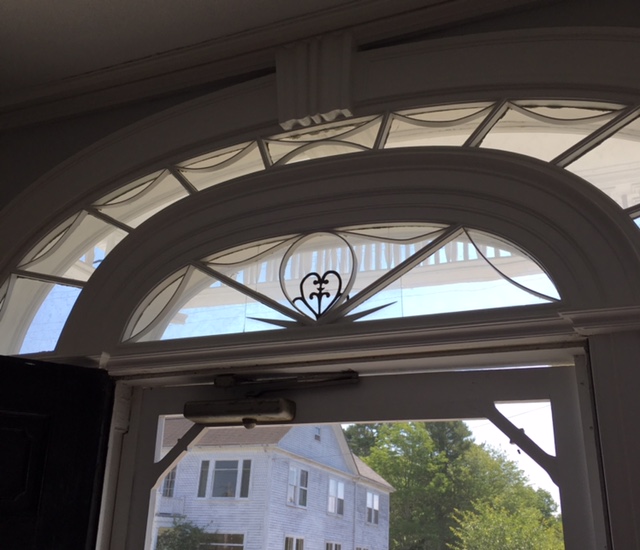
White alludes to the presence of Chandler when she writes “if your admiration prompts you to further investigation of the charms of this delightful old mansion, leave your car and step into a modest, nearby store.  Here, a most gracious lady—a true descendent of Thomas Ruggles—will greet you with charming courtesy, and will walk with you to the old home and throw wide the door.”

When visitors “throw wide the door” today, they are greeted by a stunning restoration.  Docent Roberta Bayrd of Cherryfield greeted me and we spent a delightful hour touring the house.  Well-versed in the house’s history and its artifacts, she described some of the more whimsical elements of the house’s design as “straight out of Mr. Ruggles’ imagination.”

Reed’s history of the house ends abruptly in 1955 with Chandler’s death and there’s no mention of the work of The Ruggles Society from that point forward.  In such a remote outpost as Columbia Falls, more than money would have been necessary to maintain and care for the property.  It is meticulously preserved and lovingly cared for.  I have visited many historic homes over the years and my laser-like focus doesn’t miss things like dust bunnies, dirt, and finger-printed windows.

I saw none of this.  My curiosity about the house and its upkeep is piqued by my visit.

Columbia Falls is quite far away; it requires planning to visit.  There’s a Christmas Tea on December 3 and I would imagine many members of The Ruggles Society attend.  I’ll bet I could learn a lot about the passionate members who make the house what it is.  I mentioned the tea to docent Bayrd and told her I might attend.  Her response was a simple and emphatic “you must.”

Indeed, I must!  And I promise, I will take some better pictures than the ones I took in July.

Posted in Lady Alone Traveler, Talk of The Toile | Tagged , | Comments Off on Throw Wide the Door

The Catbird Haunt

My house sits on a peninsula of sorts, the last house on the street.  There’s a gully behind the property with a small stream running through it.  This overgrown, marshy gully is the playground of woodchucks, squirrels, and the occasional deer.  I’ve seen a roving gang of raccoons passing through my yard on their way to the gully and places unknown.  There’s a lot of birds, too, and they start singing at about the same time the newspaper arrives.

This peninsula is wild and forlorn in its way, even though the busy highway is only about 300 yards from the house.

I’ve been aware of the birds since I moved in, hearing them in the morning or in the quiet times after dinner.  But I’m no bird watcher and it wasn’t until a friend visited and said “wow, you’ve got a lot of birds in your yard” that I began seeing individual birds and noticing their differences.

My awareness of their winged omnipresence has made the birds of my neighborhood excellent company during the many long, lonely hours I’ve spent in the garden this summer.  The goldfinches travel in pairs where they briefly perch in unlikely places like the long stems of tiger lilies and Echinacea.  The stems sway precariously against their slight weight and pressure; the birds seem to enjoy it, like a carnival ride.

It may very well have been the same goldfinches who broke a few branches of the volunteer sunflower tree.  I spotted one landing happily on a branch and the next day I found the snapped branch on the ground.  I staked the remaining branches to preserve the plant.

My favorite feathered friend is the grey catbird.  According to Stan Tekiela’s field guide, Birds of Maine, the catbird is a “secretive bird that the Chippewa Indians named Bird That Cries With Grief due to its raspy call.  The call sounds like the mewing of a house cat, hence the common name.  Frequently mimics other birds and rarely repeats the same phrases.”

One day I looked out the laundry room window and saw a cat bird peering in at me.

It’s a common phenomenon for grieving people to consider birds embodying the spirit of dead loved ones.  The naturalist Ernest Ingersoll, in his 1923 book Birds in Legend and Fable, wrote there was almost a universal belief that birds were visible spirits of the dead.

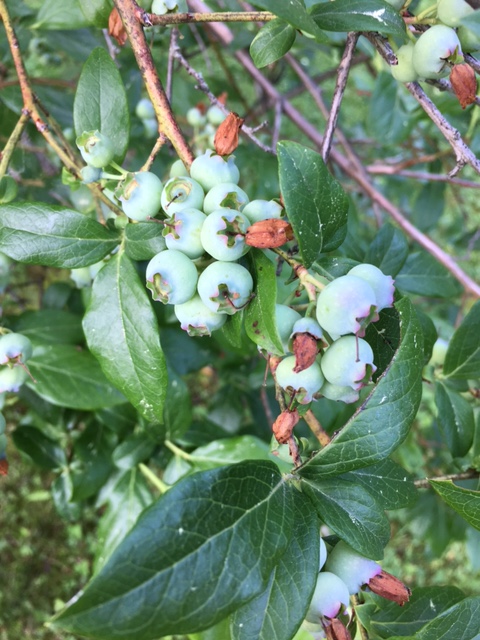
As I look out the kitchen window, I see a small grey bird in the blueberry bush.

“Catbird, is that you,” I ask.

In this long summer of grief, my haunting by the catbird has been a pleasant respite from sadder thoughts.

Posted in Weather and Seasons | Tagged , , | Comments Off on The Catbird Haunt

Somewhere in Bucksport

Late yesterday afternoon a high school classmate stopped by my house with some money for his reunion tickets.  I hadn’t seen him in a long time and while he looked almost the same as when we graduated from high school, I didn’t recognize him at first.  We got caught up a bit, talked about all manner of things from legalized marijuana to historic houses.

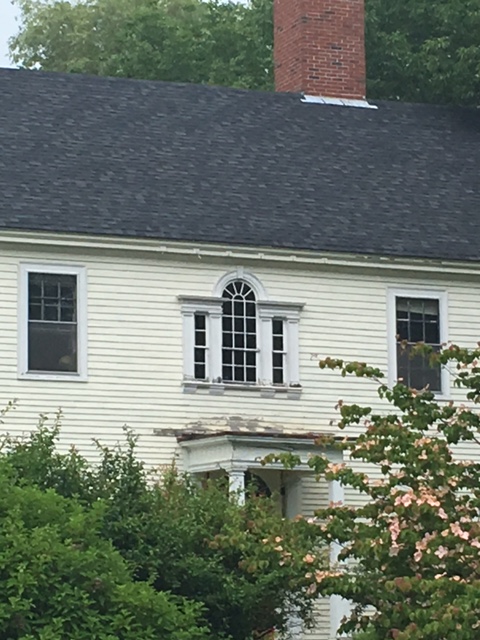
He had lived in Stockton Springs, a small Waldo County town on the road to Bucksport.  I mentioned my recent visit to the area and my meandering about the neighborhood surrounding the public library.  The area is a marvel of historic houses.  Not all were in pristine condition, but most were intriguing.

I wish I had taken more pictures of this house.  The center chimney isn’t centered and that’s curious.

What is that sound?  Oh, damn.  I hear the responsibilities of the day creeping up the staircase.  Time’s up for imagining and dreaming about a peaceful life behind the Palladian window.

Posted in Lady Alone Traveler | Tagged , | Comments Off on Somewhere in Bucksport

On the Peninsula

I promised my friend Jaxon I would work the word “hobo” into a blog post this week.  Yesterday morning, I woke up to the sound of ocean waves hitting the prehistoric rocks of the Schoodic peninsula and there were no hobos in sight.  There was only fog and the throaty hum of lobster boats heading out.

Along the roads in that world, blueberries grow.

Back here at home, there’s a Schoodic-like fog this morning.  It’s good for remembering and contemplating the time away.

In my travels, I found Louise Dickinson Rich’s 1958 book The Peninsula.  It begins with these sentences:

“Most of us, I suppose, at one time or another experience a longing for another way of life.  Suddenly our days and our energies seem to be expended on trivia.  We are overcome by a sense of being alien, of not belonging in the world in which we find ourselves, of being out of step with the times and out of sympathy with the attitudes that we encounter.  We are hungry for the fundamentals—for the satisfaction of wresting food from the stubborn earth, of raising our own rooftrees with our own hand, of combating successfully man’s implacable, hereditary foes, the wind and the weather.  We suffer a great nostalgia, which means a sickness to return home.”

There’s no time today for writing more about the land of rocks that fall from the sky, ship captains, and Daughters of the American Revolution.

The latter, from my introduction to them, certainly do not fall in the category of hobos.

Posted in Lady Alone Traveler | Tagged , , | Comments Off on On the Peninsula

On the Cutting Room Floor

On this year’s summer solstice, I attended a “farm-to-table dinner” at Pineland Farms in New Gloucester.  Apparently, “farm-to-table” is a “movement” that began somewhere in California in the early days of the 21st century.

A June, 2015, Vanity Fair article by Corby Kummer suggested the “movement” was poisoned and it was time to end it.

I don’t pay much attention to waxing and waning food trends.  I feel sorry for men and women whose finicky palates are so jaded they cannot briefly enjoy the beauty and delight of a plate of fresh peas served al fresco summer after summer.

With such an attitude, I may never win a James Beard Journalism Award.

Nevertheless, Graze at Pineland Farms, now in its fifth summer, was lovely and delicious.  I covered it for the Sun Journal and my article will run in this Sunday’s “B” section.  I managed to interview a number of interesting food lovers during the social hour and sat at a table of delightful men and women, some of whom did consider themselves “foodies” upon questioning.  Due to the space limitations of the paper, some of these interviews ended up on the cutting room floor.

I enjoyed meeting the Black Tie Company’s owner, Christine Weber.  Black Tie has been in the catering business for 30 years and Weber said putting on a five-course dinner under a tent was not a difficult task for her chef and staff.  She said “in 30 years, we’ve seen everything.”  She said the task of cooking outside was like going camping and forgetting a can opener.  Weber says the average camper asks themselves “how can we open this can” while the Black Tie team are “the ones who can figure out how to do it.”

Naturally, I asked Weber about my own entertaining nemesis, Martha Stewart.  Weber said Stewart’s 1982 book Entertaining was the first book she read on the topic.  She said it was a helpful volume as she launched her business and described Stewart as a consummate expert across all areas of entertaining.

What most impressed me about Weber was her passion for her business.  She described how she’d diversified into different catering areas over the years to grow the business and move it beyond the seasonal, weekend driven model.  She saw this as a way to hire people who could work for her year-round and by doing so, she could have a loyal and passionate staff.  She is relentless about attention to fine details and wants her customers to have a memorable experience.

My interactions with a number of Black Tie staff during the writing of my article confirmed Weber’s focus was successful.  My e-mails received a same-day response.  The staff I met at the event were helpful and pleasant and more importantly, extremely polite and professional.

One of the guests at my table, an admitted foodie who had recently eaten at Erin French’s exclusive and forever-booked Lost Kitchen in Freedom, missed one of the passed hors d’oeuvres.  A bacon, egg, and cheese slider on a biscuit with tomato jam.  She motioned for a server and asked if there were any left.  In less than three minutes, everyone at my table was enjoying this breakfast-like conglomeration, elevated to cocktail party darling by its diminutive size and a bit of jam.

And yes, if you were wondering, the food was very good.  Executive Chef Avery Richter, with Black Tie since 2013, dished up heaping plates full of delicious, course after course.  Hot food was hot, cold food was cold.

The next Graze at Pineland dinner is on Wednesday, July 26.  There will be three additional dinners on various Wednesdays through October 4.  Each dinner also features libations from a local brewery and live, farm-to-table appropriate music.

Bon Appetit!

Posted in Cooking and Food | Tagged , , , , , | Comments Off on On the Cutting Room Floor

Fireworks and Fireflies

Yesterday was Independence Day, or the Fourth of July.  Fireworks are legal in Maine now and there were a variety of “do it yourself” firework shows around town.  Some I could see from my porch and others I could hear.  While manufactured pyrotechnics lit up the sky over the trees, fireflies sparkled here and there along the road.  My street was occasionally animated by crackles and booms from the Summer Street area of town; periods of silence and darkness were accompanied by crickets and the steady pulsing flicker of fireflies

In the garden, a volunteer sunflower grows.  While this particular Helianthus is an annual, occasionally a dropped seed will survive the winter and grow the following season.  This one is the branching variety, meaning it will bear numerous flowers instead of one large flower head.  It’s a green explosion and I’m anxious to see the bloom’s type and color.  Sunflowers are August’s garden fireworks.

I like fireworks, both manufactured and natural.  According to Wikipedia, fireworks were invented in China during the 7th century.  I guess that means they’re nothing new under the sun.

The Tiger lily is another fireworks-like flower, bursting with color and spirit in time for the Moxie Festival.  Here in the three villages of Lisbon, along with Tiger lilies, we’ll have Moxie fireworks on Friday evening.

Contrary to myth and meme, the festival is shaping up to be outstanding.

It will be absent the “unofficial mayor of Moxieville,” Frank Anicetti.  Anicetti, a local icon, died this past May.  As Moxie maniacs know, Anicetti did not open his store for 2016’s celebrations, strategically retiring amid much fanfare just days before the festival.  Interestingly, Anicetti alluded to his departure from the Moxie scene as early as 2014, when he was interviewed by writer James Sullivan for an article featured in The Boston Globe’s July 10, 2014 business section.  That year, longtime festival coordinator Sue Conroy died just weeks before the Moxie began flowing.  Sullivan wrote “her passing triggered more speculation about the future of the festival, which has weathered recurring scrutiny as it threatens to outgrow the town.”  Anicetti told Sullivan in an interview “there are things happening this year.”

Anicetti was a storyteller, that’s for sure.  In spite of “things happening” the 2014 Moxie Festival was very good.  The weather was perfect, crowds thronged the shabby streets  of town, and the talented Lakeside Lutheran marching band was just one attraction that pleased visitors and locals alike.

The 2017 festival’s theme is “Moxie Salutes the Red, White & Blue.”  Retired US Army Staff Sergeant Travis Mills will be the parade’s grand marshal.  Mills, a quadruple amputee who survived an IED explosion while on active duty in Afghanistan, will also have a booth downtown during the festival.  Parade Chair Gina Mason says the parade will “probably be the biggest we’ve ever had.”  The criteria for parade excellence, as many know, is whether or not one can smoke two cigars during the event.  At least that’s the criteria former Moxie Festival organizer Noyes Lawrence uses.  “Two stogie parades” measure up.  I asked Mason if this year’s parade would be a “two stogie” event.

“You be the judge,” she said.  “Bring at least a couple.”

And the Moxie Store?  Anicetti sold it early in 2017 to an enterprising team of locals who completely gutted it and repurposed what Globe writer Sullivan described in 2014 as a “ramshackle store” with “bananas in the window and a selection of old-fashioned candy hanging on peg hooks.”  Tony and Tracy Austin, or Lisbon Pride, LLC, have accomplished much in the 60-plus days they’ve owned the real estate, converting it into a pub called “Frank’s.”  When I ride my bicycle to the post office, I look at this miracle with wonder.  The building itself, never much architecturally, has shaped up into a small town work of art.

Not too shabby anymore.

If you’re planning a visit the sleepy little town along the Androscoggin River for fireworks, fireflies, or Moxie, you be the judge of all these things.  And don’t forget your stogies.

Posted in You've Got Moxie! | Tagged , | Comments Off on Fireworks and Fireflies

Deconstructing Ugly

I was very busy last week.  I spent my free time in an old building, dusting and decluttering a collection of archival artifacts.  I went to a “farm to table” dinner and talked to more than a few foodies.  I chased stories for the Sun Journal‘s Basilica series and I had the distinct pleasure of walking with an old friend, talking about beauty.  As I sit here composing this post, I’m untangling some ugly green metallic string I bought 20 years ago.

Behold the beautiful dish of whipped butter.

Gaze upon the simple ceramic ramekin, the workhorse of the restaurant world.  Imagine the soft, rich goodness of the butter, extended and enhanced by whipping with chives.  Meditate upon the simplicity of the purple flower, adorning this delicious creation.

It was so beautiful I took a picture of it.

Today, it’s not easy to label things as “beautiful” or “ugly.”  I’m not suggesting it is always one or the other.  Sometimes there are gray areas of simplicity, utility, and form which transcend labeling.  Consider the plain coffee mug, which provides the early morning jolt and is then whisked lovingly into the dishwasher.  It is not ugly or beautiful.  It is purposeful.

Although it’s not politically correct to label things, we all know something beautiful when we see it.  (Notice I said “politically correct” and not “polite.”  There is a difference here as well.)

Yesterday, I found my copy of The Decoration of Houses by Edith Wharton and Ogden Codman, Jr.  Wharton, a lover of the beautiful, once described the exterior of her Newport house, Land’s End, as “incurably ugly.”

What a refreshing time that must have been, to say it like it was and have no fear of social media reprisal, job loss, and shaming.  I often wonder what Edith Wharton would say if she were time-traveled into 2017.  Would she boldly tell it like it is and address the “incurably ugly” things all around us?  According to Jonathan Franzen’s 2012 New Yorker article written in celebration of Wharton’s 150th birthday, Wharton was “hostile to the rawness and noise and vulgarity of America…she was the kind of lady who fired off a high-toned letter of complaint to the owner of a shop where a clerk had refused to lend her an umbrella.”

Franzen made the mistake, early in his essay, of writing “Edith Newbold Jones did have one potentially redeeming disadvantage: she wasn’t pretty.”

This sentence, early in the article, unleashed a furor of op-ed pieces.  You can search the internet yourself and see things like “Jonathan Franzen is a sexist!” and “Jonathan Franzen is a pig.”  Perhaps, somewhere in the lower intestinal tract of the internet, someone even said “Jonathan Franzen is literally Adolph Hitler.”

I have a 1994 illustrated biography of Edith Wharton, written by Eleanor Dwight.  I’ve looked at its portraits and candid photographs of Wharton; the formal images are limited.  Many are blurry.  Edith Wharton was plain; she was not celebrated for her looks.  She was celebrated for her writing.  Franzen celebrated her writing in his article, too, but I don’t know how many critics read beyond his faux pas.

I’ve read four of Wharton’s novels.  I enjoyed them and would read them again, time being of no consequence.  I’ve referenced and skimmed The Decoration of Houses, but reading it completely now is important as I contemplate my summer historic house visits.  Wharton’s volume kicks aside other nightstand books by Henry Beston and Patrick Leigh Fermor.

Ugly, isn’t it?

Posted in Books and Reading | Tagged , , | Comments Off on Deconstructing Ugly

Echoes of Maine

In February of 2016, I took a trip to Aroostook County.  It was a whirlwind tour and I absorbed as much of the County as I could in the 48 hours I spent in that remote part of Maine.  In a card shop somewhere along the way, I picked up a copy of Echoes magazine.  Billing itself as “The Northern Maine Journal of Rural Culture,” it was edited and published quarterly by Kathryn Olmstead.

Olmstead, a transplant from Michigan, is a former associate professor and dean of journalism at the University of Maine at Orono.  She taught a class called “Newspaper Design” that I took my senior year at the stein-raising state university.  I am not sure how Olmstead got from Orono to Caribou, but she began editing and publishing Echoes in 1988.

The magazine is well-designed, thoughtfully composed, and carefully edited.  It’s not flashy, trendy, or slippery shiny like other magazines of Maine.  It features poetry, photography, fiction, and regular columns.  Its purpose, in part, is as follows:

“…the magazine focuses on positive values rooted in the past that have relevance for the present and the future.  Echoes suggests that knowledge of rural experiences can help us live in modern society – that there is permanence in the midst of change and value in remembering our roots.  Echoes is a portrait of home, whether home is a place or a time, a memory of the past or a vision of the future.”

When I returned home from the County, I subscribed to the magazine.

Yesterday, I got a photocopied letter from Kathryn Olmstead, announcing the upcoming issue of Echoes would be its last.  Olmstead wrote:

“Despite the enthusiasm of Echoes readers and our genuine pleasure in giving voice and visibility to writers, artists and photographers since 1988, the realities of the marketplace have finally forced us to cease publication.”

Although I don’t know Olmstead personally, all the visible evidence of her work in the magazine and her articles for the Bangor Daily News suggest she is not impulsive.  Her writing is steady and solid; if that’s any sign of her character, I imagine she’s been considering the “realities of the marketplace” for more than one or two quarterly issues.

Subscribers’ remaining issues will be fulfilled with monthly copies of Maine magazine, published by the Maine Media Collective.  Maine magazine, from my skimming of it, covers the north and easterly corners of the state as regularly as Down East magazine.

You know, endings and conclusions are difficult.  As a writer, I always struggle when I get to the end of a blog post, a newspaper feature, or even a personal letter.  Sometimes, I don’t have enough information or expertise to reach a conclusion.  Other times, I think my conclusions are wrong, based on a lack of information or expertise (see previous sentence).  My feedback loop makes for lousy endings.

Nevertheless, please don’t mistake my silence for a lack of thought, emotion, and opinion.

It’s the first day of summer here in Maine…radishes, ripening blueberries, and rose Campion flowers are in abundance as I contemplate the soon-to-arrive last issue of Echoes.

Posted in Books and Reading | Tagged , , | 1 Comment

When Jell-O Stalked the Earth

The regular suspects made their annual pillage of the ancient rhubarb a few weeks ago, leaving a few stalks for the family.  The thieves are two of Uncle Bob’s “acquaintances” who visit his garden every spring and help themselves to the rhubarb.  He doesn’t even know the name of one of the culprits; she just shows up and helps herself to the best of the rhubarb stalks.

The Baumer family rhubarb hit its popularity nadir in the mid-90’s when the women in the family were tired of the herbaceous perennial.  Nana and O’Pa were both gone and Uncle Bob settled into his role as manager of the family house and gardens.

That’s when the thief first arrived.  Seeing an opportunity, she seized her first armload of stalks.  She’s been here and gone already this spring, leaving the patch half bald.

Fortunately, Uncle Bob prevented the plants from going to seed by cutting off the flower stalk.  I’ve helped myself to some of the second-growth and made a batch of stewed rhubarb.

Maine cooking doyenne Marjorie Standish says in Keep Cooking – The Maine Way  “Call it rhubarb sauce if you wish, but have you ever noticed that a lot of cooks refer to stewed rhubarb?  Probably that is old-fashioned but it is nice, isn’t it?  In Maine, the double boiler method of cooking is used.  After all, it is such a simple way to make it.”

Her recipe is “the very best” if I may use Standish’s own style of writing.  She filled her newspaper columns and cookbooks with strong superlatives.  She wrote “of course butter gives the very best flavor,” and a certain cake was “the tastiest.”

As she suggests, it’s simple to make rhubarb sauce in a double boiler if you’re hanging about the kitchen for an hour.  Just be careful to keep water in the saucepan to prevent it from burning.

This year, I made my stewed rhubarb following Standish’s post-script suggestion to replace half of the sugar with a third of a box of dry strawberry gelatin.  I stirred it in after the sauce was complete and I’d removed it from the heat.

Popular gelatin brand Jell-O was a product of modern refrigeration and clever post-World War II marketing.  Standish would use it liberally in the salad sections of her cookbooks.  Today’s foodies snobbishly wrinkle their noses at the sweet, chemically tainted thickener, but it’s a pleasing addition to stewed rhubarb at a time when local strawberries are not yet available.

There was a time long ago when Jell-O quiveringly stalked the earth.  Now forgotten as a aspic additive like the fins on a vintage car, the thickener is more popular as a booze transport than a shimmering dinner salad.  Rhubarb thieves, food memory holes, and superlatively good cookbooks…I do what I can to keep the past alive.

Posted in Cooking and Food | Tagged , , , | Comments Off on When Jell-O Stalked the Earth