
I last blogged about Eloise Jordan in “Just Maine Folks.” Research on granite quarries, civil defense, and fallout shelters interrupted my progress, but as I’ve paged through digitally scanned decades of Lewiston newspapers, I’ve kept my eyes open for traces of the local writer.
My research stalled out in 1961; as I looked through the December 2, 1961 Evening Journal, I noticed it was a Saturday edition, the day the paper featured Jordan’s weekly column. It was the beginning of the Kennedy era and the Cold War was heating up. The Federal Reserve, according to an Associated Press article, gave permission for commercial banks to offer savers 4 percent interest. Ward Brothers, the elegant clothing store formerly located on Lewiston’s main thoroughfare, was selling ladies London Fog brand all-weather coats for $32.50. “Can you think of a more practical gift?” asked the advertisement.

The paper featured a long feature by Jordan titled “First Parish Church of Portland is Edifice of Notable Features” and although she doesn’t note her sources, it included a historical timeline dating back to the congregation’s establishment in 1674.
Also in Saturday’s usual spot was Jordan’s weekly column, this one titled “The Scrapbook.” Jordan reflects on a scrapbook she’d owned since her youth. What’s interesting and odd about the column, which you can read here, is her use of the first person to write about herself in the third person.
“A little girl I used to know who had ‘Dutch-cut’ auburn hair, a longing to be an author, and a penchant for cats, treasured a scrapbook when she was a child that was filled with newspaper and magazine clippings…”
Apparently, the scrapbook was a discarded notebook “which originally belonged to her lumberman father” and the date “1911” was written inside. Jordan writes that the little girl’s mother started the scrapbook for the little girl “long before she was old enough to make it for herself.”
Jordan’s technique, writing about her younger self as an outside observer, sounds awkward and self-conscious today. We’ve grown accustomed to reading first person narratives. After all, isn’t that what a blog is?
Technique aside, this is an important column because it reveals some of Jordan’s early literary influences. She says the scrapbook included an article by earlier Evening Journal columnist Mabel S. Merrill. “She did not know Mabel Merrill then and it was many years before the lady with the pen became the little girl’s intimate friend.” The scrapbook also includes clippings from other Evening Journal writers and “verses of many kinds adorn the pages…”
The column reiterates her “penchant for cats” with an “illustrated poem showing a distracted mother cat and her three roguish kittens going through daily events in the fashion of people and much like the delightfully pictorial cats on foreign postcards.”
Finally, the column ends with a reference to the scrapbook’s last pages. Jordan says it’s “another invaluable article” about Richmond Island off Cape Elizabeth “which is treasured by the little girl whose family’s roots were there.”
From a research perspective, this column is rich with clues about Eloise Jordan both as an individual and an archetype. The influences and themes in this column, such as her lumberman father, cats, poetry, and her Daughter of the American Revolution roots, will occur again in her columns and features.
It would be easy to conclude Eloise Jordan was a lonely spinster, the equivalent of today’s “cat lady.” Typing and toiling in her moth-eaten fur coat, Jordan was 54 year’s old when she wrote “The Scrapbook.”
Truth be told, I have “mixed emotions” about Eloise Jordan’s writing. I don’t know if her “story” is one worth telling. Maybe she’s just a footnote in an old book destined for the library’s next book sale. Or maybe she’s part of a larger truth which has been peppered with ugly lies over the years.
Let the research continue, as I don’t think I’ve arrived at the end of the “scrapbook” yet.

 A few weeks ago, I visited the Maine Historical Society’s library. Spending several hours in this oasis of quiet and written things was a special treat. I was able to study the actual typewritten profit & loss statements of a now-defunct business, read old letters written by their employees, and analyze other company documents someone thoughtfully saved. It was a fascinating puzzle.
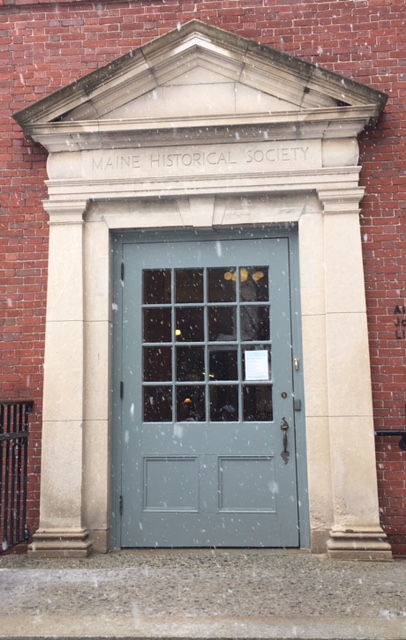 Many of the library’s visitors come to do genealogical research. A video posted on the library’s website tells the story of a member who initially visited with a goal to establish the lineage necessary to become a member of the Daughter’s of the American Revolution (DAR).
 It’s one thing to write about food; it’s quite another to prepare delicious food. One does not necessarily lead to the other. The shining moment in the whole food fiasco was waking up later in the day and finding the bland bag of Fritos was just the tonic I needed to restore my equilibrium.
 No dogs, no driftwood sculptors, no one. It was the bitterly cold beach, or Bitterly Beach for short.

 Julie-Ann Baumer