The Clipper Merchant Tea House

A few weeks ago, I took a ride to Bridgton to meet Melinda Thomas, tea mistress at the Clipper Merchant Tea House.  Located in the historic William Perry House at the top of Main Street, the Tea House is charming and inviting.  Melinda is lovely too, calm and serene as she brews a pot of rooibos for me.  We had a pleasant chat, an interview really, for an upcoming Sun Journal article about the tea shop.  She promised to send me a recipe for an Earl Gray cake and then she gave me a tour of the tea house.

I left with a small bag of black tea, something Melinda called “Ambrosia.”  According to the tea house website, Ambrosia is “the perfect afternoon tea…bursting with flavor and full-bodied to lift the spirit.”

I spent some time walking about Bridgton, a quaint town with lots of interesting shops and sights.

I recorded my interview with Melinda and I’d have to listen to the whole thing to accurately recapture her thoughts on coffee versus tea, but it was something like tea is a slow burn and coffee is jet fuel.  We talked a bit about how Americans love coffee and that maybe they are more violent because of it.

I don’t know.

Here’s what I do know:

Not everything is urgent.

My last Basilica article will run this Sunday, October 30, in the Lewiston Sun Journal and you should read it.

And it’s almost time for afternoon coffee because I need my jet fuel to make it through this day.

Posted in Cooking and Food | Tagged , , | Comments Off on The Clipper Merchant Tea House

The Wrecking Ball of Time

I’ve been writing a year-long series about the Basilica of Saints Peter and Paul in Lewiston, Maine.  It has been a time-consuming project and I’ve undertaken it in addition to my full-time work at an “intellectual sweatshop.”  I did also organize and execute my 35th high school reunion in the midst of this; I thank the Gendron Franco Center for making the event come to life.  Honestly, I knew the food would be good and plentiful, the venue would look lovely, the sound would be perfect, and the overall atmosphere conducive to conversation and conviviality.  I was not wrong.

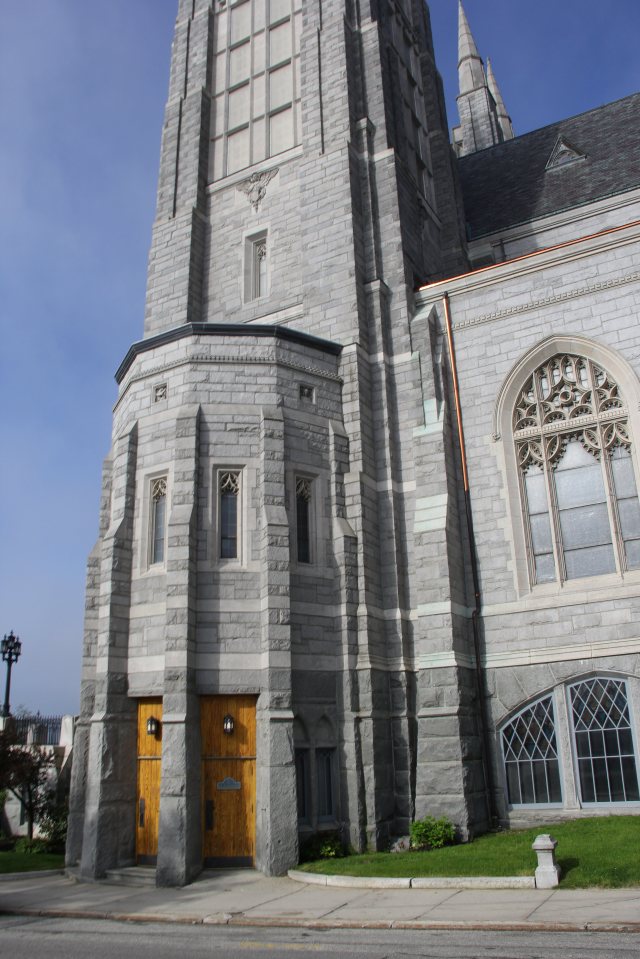
The Gendron Franco Center is located at the corner of Cedar and Oxford Streets in Lewiston, near the Bernard Lown Peace Bridge crossing over into Auburn.  Formerly St. Mary’s Church, construction on the edifice began in 1907 and was completed in 1927.  On Friday, October 12, 1934, the Lewiston Evening Journal published a picture of the new organ and announced the dedicatory concert to be held on Sunday evening, the 14th.

The organ was a gift of Reverend Desilets, who served the parish from 1911 until he died in 1924.  The money earmarked by Desilets was “left at interest for ten years after his death” and then used to purchase the organ.

The article said “the organ has almost 3,000 pipes and has a stop arrangement that is unique with this one.”  It does not say the brand of organ, but it was not a Casavant Freres.

Over time, the population of Catholics in Lewiston’s Little Canada neighborhood decreased.  The population of Catholics in all of Lewiston/Auburn decreased.  And as has been written about in many other places, Maine has the lowest church attendance in the nation.  Maine is a wildly beautiful place in many ways, but it is a burnt over spiritual mission field for Catholics and Protestants alike.

In July, 2000 the Roman Catholic Diocese of Maine closed St. Mary’s church.  It was the first church closing in the Lewiston/Auburn area.  A Lewiston Sun Journal article published on February 4, 2000 hinted at the sad day to come for those parishioners still attending the church.  George Cloutier, who had gone to St. Mary’s most of his life, said it was “pretty hard to take.”  The article noted “inside the church, the stairway up to the choir loft has fallen into disrepair and it has been years since the pipe organ was played” and “unable to retain an organist, the church’s music is now provided by a small electric piano, and the pipe organ has fallen into disrepair.”

The 1934 dedicatory concert featured visiting organist Rodolphe Pepin, the organist of St. Jean Baptiste church of Lowell, Massachusetts.  Pepin was also a composer, noted for his own work.

It must have been a lovely evening.

It’s interesting to think about the 66 years between 1934 and 2000.  What did the stairway to the choir loft look like?  When did it begin to fall into disrepair?  Who first noticed it?  Did they tell anyone?  If so, what happened next?  That’s a story to think about.

The writer of the Sun Journal’s February 4, 2000 article quoted Earl Shuttleworth.  I’m sure the author meant “Earle G. Shettleworth, Jr., the former head of the Maine Historical Preservation Society.  What Shettleworth said regarding St. Mary’s demise was “If people are concerned, they should set up a nonprofit support group and find new uses for the church.”

Fortunately for St. Mary’s Church, former Lewiston Mayor Lionel Guay and Rita Dube were concerned about the edifice in its late stages, in spite of the disrepair.  They formed a non-profit to buy the church and worked diligently with a group of concerned men and women to restore the building.  They created what is now a cultural heritage center and an entertainment venue.  Guay still serves on the board of directors for the Gendron Franco Center.

In my research on the Basilica of Saints Peter and Paul, I’ve learned quite a bit about the disrepair of the church which prompted a massive restoration that began in 1991.  Historic preservation was important to a group of concerned men and women in the parish.  As my dear philosopher friend “At Your Service” reminds me, the Basilica has become a monument, but perhaps an accidental monument.  Can the parish continue to support it?  Who are the concerned citizens who will step forward if the church can no longer support the care and attention such a massive building requires to keep it from falling into disrepair?

I did interview the project manager for the restoration.  He said the building is structurally sound.  He also said the attached monastery is structurally sound.

But things are not perfect.  If I ruled the world and had at least a million dollars, there are things I would do at the Basilica.

These were the things I wrestled with this week as I wrote my penultimate feature.

Historic preservation requires time, human “resources,” money, and vigilance because, dear readers, time is a wrecking ball.

Posted in Just Writing | Tagged , , | Comments Off on The Wrecking Ball of Time

The Flowers of Life

Last Sunday, the “Basilica Brides” piece ran in the Lewiston Sun Journal.  My lovely neighbors, Dot and Alfred (Breezy) Galgovitch were one of the couples featured in the article.  The front page of the “B” section showed them in early wedded bliss, posing on the steps of the Basilica on June 25, 1946.  Breezy had just returned home from serving with the 10th Mountain Division of the 5th Army in World War II.

Dot and Breezy are a popular couple.  Everyone in town knows and loves them.  I was at their house briefly on Sunday and their phone rang and rang with congratulatory messages about their newspaper fame.  It was like they were newlyweds again.

Seventy-one years of marriage.  They deserve some recognition and fame.

My phone rang a few times too.  One caller, Jacqueline Bellegarde, called me to relay a Basilica story.  I was able to confirm what she said by doing some quick newspaper research.

On Saturday morning, June 24, 1944, Jacqueline’s father, Thomas Marquis stopped at what was then known as Saints Peter and Paul church to recite his morning prayers.  While praying in a pew in the rear of the church, he died of heart failure.

Oddly enough, according to his daughter and his obituary, his father Aurele Marquis “died in a similar manner 14 years earlier.”  Not at Saints Peter and Paul church, but at St. Mary’s Church on Cedar Street.

The day Thomas Marquis died, there were two weddings at Saints Peter and Paul church.

What more is there to say?  The Basilica was a busy place.  Babies were born and baptized, children made their first communion and were confirmed; men and women married in the church.  They died and were buried.  Speaking of which, in the event I can’t score an interview with the Bishop this week, my last piece on the Basilica may very well be on Saint Peter’s Cemetery.

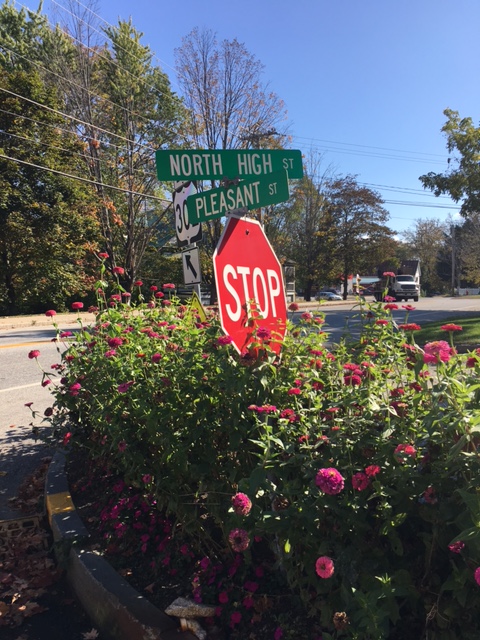
What with all this talk of sacramental ceremonies, it’s a good time for an October floral interlude.

Posted in Garden Chic | Tagged | Comments Off on The Flowers of Life

Vive la Canadienne

As my blog readers know, I’ve been writing about the Basilica of Saints Peter and Paul in Lewiston, Maine for the last 8 months.  This Sunday’s Sun Journal (October 8) will feature the “Basilica Brides” story followed by three additional articles.  October 15 is tentatively titled “Potpourri of Images” and will feature photographs that didn’t make it into the series for one reason or another.  Things like the “dragon devil door handle” I spotted on the Blake Street side of the building.  Then October 22 will be (hopefully) an interview with either Father Nadeau or the Bishop about the edifice’s future.  The last article, a first person narrative, will be about the writing experience.

The end of this long writing trek is in sight.

The other day, I overheard an elderly local say “I’ll be glad when that Basilica series is over.”  I laughed and a variety of responses circled around the synapses.  Even in their long, slow decline, Lewiston’s French Catholics continue to annoy the Protestants.

For a moment, I wondered about the reader’s comprehension abilities; the series hasn’t been about Catholicism.  It’s been about many things, but mainly about the history of Maine’s largest ethnic group.  Surely, you realize that 24% of Maine’s population self-identifies as Franco American?  Writing about what mattered to this large ethnic group is important, not just to me personally as one of them but to a large number of Maine’s population.

This work is about Lewiston, but it could be the story of any New England mill town.  What did this group of people think?  What did they build?  What remains?  My research into the lower church’s construction reminded me of the tenacity and patience these people had, waiting thirty years for the completion of their cathedral.  It reminded me of Israel Shevenell, Biddeford’s first French-Canadian.  He walked almost 200 miles from Compton, Quebec to Biddeford in 1845 to find work as a bricklayer.

Waiting, writing, or walking, drawing valuable attention to Lewiston’s ancestors and what mattered to them is important.  It’s been exhausting and it hasn’t been easy.  Blog reader “Loosehead Prop” says “like most good and important things, it doesn’t feel all that good and important when you are actually doing it, but it is nonetheless good and important.”

The Gendron Franco Center will be screening a film about Israel Shevenell, The Home Road, on Sunday, November 19, 2017 at 3:00 p.m.  I’m looking forward to going and bringing some of my ancestors.

Vive la Canadienne!

Posted in Just Writing | Tagged , , | Comments Off on Vive la Canadienne

At the Old Hitching Post

As noted earlier on this blog, Echoes magazine ceased publication in June of this year.  Any remaining subscription issues were fulfilled by Maine magazine and as of today, I have received two months of this replacement.  It’s a happy harlequin of a magazine; paper soothing to the touch and stories pleasing to the eye.  Features are rarely more than 500 words and most are filled with staccato paragraphs and bullet points.  It requires very little intellectual involvement.

Yesterday, I received their 2017 annual wedding guide, called wedmaine and insouciantly subtitled “your guide to how we get hitched throughout the state.”

Interestingly enough, a feature I’m working on for a Sun Journal Basilica installment will feature a few “brides of the Basilica.”  There were likely many, many weddings in the original red brick St. Peter’s Church between its dedication in 1873 and its demolition in 1905.  Similarly, the path to the altar was tread early and often at the lower “crypt” church, which served Lewiston’s French Catholic population from 1906 until the dedication of the upper church in 1938.  The story of that patient and faithful community is a long one and requires more intellectual engagement than I’ll be able to muster up here on today’s blog post.

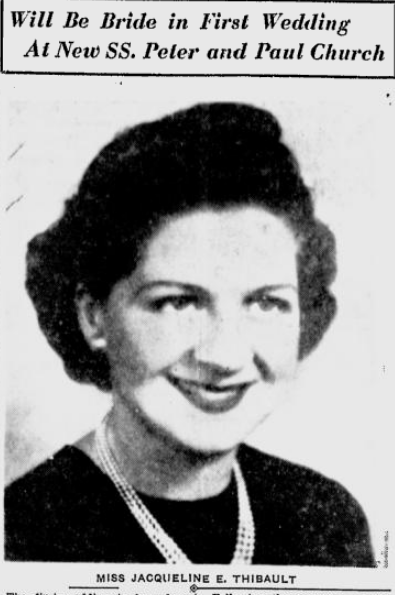
The first couple to wed in the upper church was a local one.  The Monday, October 24, 1938 Lewiston Daily Sun featured the bride’s engagement photograph and wrote “the first wedding to be solemnized in the beautiful new SS. Peter and Paul church which was dedicated Sunday is taking place this morning when Miss Jacqueline E. Thibault of Lewiston becomes the bride of Laureat E. Roy of Auburn.  Rev. Fr. Dumont of Fall River, Mass., a college friend of the bride’s father, will perform the double ring service, and music will be furnished by the parish organist, G.G. Giboin, and Louis Restori, vocalist, who will sing an Ave Maria.  There will be no attendants.”

Mrs. Roy was 21 years old when she got married and she was beautiful in her engagement photograph.  She died in her home at the age of 93 after a brief illness.  Her obituary noted she had worked as a hairdresser in Portland and then took care of her two daughters.  She and her husband remained married for 61 years until he died in 1999.  Her obituary mentioned “her joie de vivre and positive attitude will be missed by all” and the photograph showed an older but still beautiful woman.  Her “joie de vivre” radiated through it.

I have been unable to reach her daughters for an interview; I will keep trying.  I would like to know more about Miss Jacqueline E. Thibault.

My next-door neighbors were married at the Basilica in 1946.  I’m sure they’ll have a few interesting things to tell me about “getting hitched” at the Basilica.

The many Basilica brides, grooms, and myself request the honor of your presence on Sunday, October 8, 2017.  We’ll be at the old hitching post, reading the Lewiston Sun Journal.

Posted in Just Writing | Tagged | Comments Off on At the Old Hitching Post

Granite Narratives

For the past eight months, I’ve been writing a series of articles for the Lewiston Sun Journal about the Basilica of Saints Peter and Paul.  These articles are archived online and you can read them there.

How I got involved in this work is a long and ironic story, interesting only to myself and a close circle of friends and fans.  Nevertheless, since my first article ran on February 12, 2017, the massive granite edifice has lived “rent free” in my head and I’ve learned so much about the building, the city, and the generations of French Canadians and Franco Americans who consider this church their spiritual home.  Six article remain in the series.

The Basilica story is a long and complicated one.  In the local narrative, it’s often called “the lunch bucket church” or “the church built with nickels and dime.”  That’s how a narrative is created.  Someone uses an overly simple expression to describe a complex person, place, thing, or situation and “voila.”  The narrative.

Create a narrative and many loads of new and contrasting documentation can’t change it.  Like a sound bite, it’s very difficult to overcome the damage of narratives.  Worse, truth is sometimes layered over a lie and the damage of misunderstanding is compounded.

Here is an example from the Basilica.

One of the important source documents I’ve clung to in my research is Father Antonin Plourde’s Cent ans de vie paroissiale, written in 1970 for the 100th anniversary of the Dominican Brothers’s service in Lewiston.  Father Plourde documented that construction of the upper church began on May 23, 1934.  He wrote “La nouvelle eglise necessite 515 wagons de granite de North Jay.”

Looking at it quickly, a non-francophone might think 515 “wagons” of granite.  515 wagons of granite became “the narrative” and you can find this description in many historical accounts of the Basilica’s construction.

The word “wagon” connotes an image.  I see a horse pulling a wagon.  But it was 1934 and no one was moving things around Lewiston with wagons.  After researching the North Jay granite quarry and their granite delivery system, I know the granite arrived by train car to the railroad terminal once located on Bates Street in Lewiston.  There were also a number of stone-related businesses located there.

Was it 515 train cars full of granite?  I think so.  My research confirmed the granite was marketed, sold, and delivered in train cars in 1934.  515 carloads of granite are much more than 515 wagon loads and that sounds about right for such a massive structure.


Did you know not all of the granite came from North Jay?  No, me neither.  Not until I started pulling apart Father Plourde’s history.  But it’s true.  The edifice of the lower church, or the “crypt” was built with Norridgewock (Maine) granite, mostly likely from the Dodlin Hill quarry.

I’m exploring the construction of the lower church this week and next as we race into the homestretch of the series.    I hope you’ll read it.

Posted in Just Writing | Tagged , | Comments Off on Granite Narratives

In Heavenly Blue

I planted “Heavenly Blue” morning glories this year and I waited eagerly for their arrival.  I like the purple “Grandpa Ott’s” but the blue ones are my favorite.

One bloomed today.

Today, our town will bury my Moxie BFF and mentor, Gina Crafts Mason.  Click on the “Heavenly Blue” to read her obituary.

“Gina loved the town of Lisbon.  Many times she said that she wished Lisbon had a mayor because she would have loved to run for the office.”

I wrote a blog post once that began “When I moved home to Maine, I knew things were going to be different.”

My life IS different, in part thanks to Gina Crafts Mason.

Posted in You've Got Moxie! | Tagged , | Comments Off on In Heavenly Blue

Stop Watching the Clock

I had a much different blog post scheduled for today, a polemic on social media, Tee Vee advertising, and men’s jeans.  I called it “Opera Jeans” and although I hadn’t crafted how it would hang together on the page, it was pretty darn funny in my head.

Something came up, though, and I wasn’t able to orchestrate the production.  One of those events where everyone says they have “no words” but then proceed to have many words.

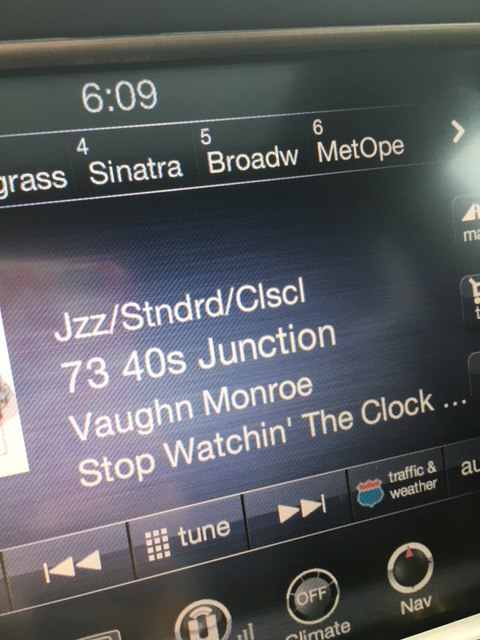
I love Vaughn Monroe.  I love his soothing baritone voice, full of confidence and style.  He was a man of another time.  I had never heard this particular song until recently and I loved it.  The lyrics are jingoistic and American, but countering clock watching appeals to me today.

Life is short.  Stop watching the clock.

Posted in You've Got Moxie! | Tagged , | Comments Off on Stop Watching the Clock

Letting Yourself Go

I got a letter from a friend the other day, full of late August angst.  “August is one of those months where I feel like I’ve wasted my life,” she wrote.  “The summer is gone and I have done nothing that I wanted to do.”  I could certainly understand what she was saying.  Why, just the other night I finished reading a book, the only book I’d read all summer.  My brain is practically atrophied from lack of reading.

I hurried to bang out a letter to my friend and I slipped it into the recently read book, Louise Dickinson’s The Peninsula.  Published on October 15, 1958, Rich outlines the history and geography of the Gouldsboro peninsula from her years living in Corea and Prospect Harbor.  The book, filled with wit and Down East humor, also has enough philosophy to lift one’s spirits during these dark days of August.

Rich is most noted for her book We Took to the Woods, written in 1942.  It chronicles the years she and her husband Ralph lived in a camp in the Rangeley Lakes region of Maine.  Following her husband’s death in 1945, Rich returned to her home of Bridgewater, Massachusetts and supported herself and her two young children by writing books about Maine.  A friend offered her a cabin on the Schoodic Peninsula and she became a regular visitor.

We Took to the Woods is part Thoreau and part “let’s get away from it all; The Peninsula, too, is a place Rich describes as “being outside time and space and life itself.”  Fishermen who wear oilskins, (not Grundens) fill the pages alongside their wives, the local storekeeper, retired sea captains, and aging aunts.  At the time Rich wrote the book, progress had not reached across Frenchman’s Bay despite Bar Harbor’s steady popularity as a summer destination.  Peninsula residents and visitors alike still met at the store after daily “chores” to pick up their mail, share news, or to make a phone call.  Industrious and creative, the Peninsulans in Rich’s book were not likely to approach August’s end with ennui.

According to Rich, Peninsulans were also not distracted by the latest bright and shiny thing.  “The danger of the laborsaving device,” she wrote, “is that it too often produces idleness rather than leisure—and there is a big difference.  Leisure is something earned by work, a reward to be savored and enjoyed.  Idleness is a form of poverty, a lack of employment, and conducive to waste of time and talents.”

Like the locals, Rich kept herself busy at her cabin on Corea’s Cranberry Point.  When her chores and her writing were done, she explored the landscape, the old cemeteries, and visited her neighbors.  She made an impromptu visit to storekeeper George Crowley’s aging sisters who lived “up the Guzzle in the house by the old silver mines.”  Rich’s knock found the ladies, in their early 90’s, in their kitchen giving each other home permanents.  Rich is surprised and they tell her “but if you once started letting yourself go—Well!”

Faunce Pendexter, writer for the Lewiston Evening Journal Magazine, reviewed the book on November 1, 1958 and wrote “this reviewer is happy to comment that The Peninsula avoids what so many books about Maine and Maine people have been guilty of:  Mrs. Rich doesn’t seek to make Pine Tree staters quaint or peculiar.”

Rich herself wrote “I hesitate to use the word picturesque in connection with it, because picturesque and quaint are two words of which the Peninsulans take a dim view when applied to them or theirs.  They are summer-people words, pregnant with patronage.”

Old books like Louise Dickinson Rich’s The Peninsula are just right for the last dark days of August and the brighter possibilities of autumn.  It’s certainly not time to let yourself go.

Posted in Books and Reading | Tagged , | 1 Comment

Into the Cosmos

This spring, I planted a package of Cosmos flower seeds in a small garden bed adjacent to the back steps.  This spot is also home to a Stella de Oro daylily and a late-blooming hibiscus.  Last summer’s Grandpa Ott morning glories showed up again this year too.  It’s a busy spot.

I’d never planted Cosmos before and reading the packet reminded me I once had an album by the folk duo, Aztec Two-Step.  The 1972 vinyl long-play record, self-titled “Aztec Two-Step” featured popular songs like “Baking” and “The Persecution and Restoration of Dean Moriarty” as well as “Cosmos Lady.”

The latter song was not about flowers; I don’t know what it was about.  Even though I listened to it a hundred times, I never paid much attention to the words.  “You asked me if I fly, and I answered you with my eyes.  Astral projections, cosmos connection beyond the skies…cosmos lady.”

Clearly, this was not a song about flowers.  And “Baking” probably wasn’t about bread either.

There was a great deal of interest in the cosmos this past week as the United States witnessed a total solar eclipse on Monday, August 21.  The experience was brief here in Maine; I was at the dentist getting my teeth cleaned.  When I left the office, I did look at the sun for one second and could view the astral projection.  Interestingly, Monday was the day my first Cosmos flower bloomed.  Coincidence?

There’s a lot of green foliage with very few flowers.  It’s like an assortment of old folk songs; there must have been lots of green foliage behind those musical flowers, if you get my astral projection.

Speaking of spiritual catharsis, I’ve just begun researching the gentleman who built my house and many others in Lisbon.  His name was W.D. Blethen and he was born across the river, in Durham, in 1838.  He learned the building trade by working as a carpenter for a number of years, and then in 1891 bought a large pasture on the south side of the main road through town.  Many thought he was foolish to do so, but he turned the pasture into a suburban street and according to The Lisbon Enterprise Magazine (undated photocopy) it was a “fine little street located here with no less than seven snug dwelling houses and the eighth in the course of construction.”

In my research, I found Mr. Blethen listed in an 1899 “Spiritualists Directory” as a member of the “First Maine Spiritualists’ State Camp Meeting Association.”  This group sponsored an annual camp meeting at Buswell’s Grove in Etna.

The camp still exists as Camp Etna.

Camp Etna reportedly began hosting spiritual retreats in 1876.  They incorporated in 1899.  In 1919, they changed their name to the Etna Spiritualist Association and continue under that appellation today.

Mr. Blethen was an enterprising builder and business man.  It’s early in the research and his association with Camp Etna, spiritualists, and the cosmos is unclear.  It will be interesting to learn more about him and other Lisbon builders as I prepare for a 2018 talk at the local historical society.  The talk will discuss the architecture, style, and provenance of the town’s residential dwellings.  The date is to be determined; please stay tuned.

Posted in Garden Chic | Tagged , , , , | Comments Off on Into the Cosmos