I’m sad when a barn isn’t a barn anymore.
The loss is tolerable if they’re selling local donuts.
I’m sad when a barn isn’t a barn anymore.
The loss is tolerable if they’re selling local donuts.
What is Twitter?
The noun and verb forms of the word “twitter” sit in my Webster’s New Collegiate Dictionary between the words “twitch” and “twixt.” I like the noun form best:
Now I understand my aversion to the short messaging service named Twitter. It’s the giggle. @AuntTomato (my Twitter handle) never giggles. In fact, she doesn’t laugh much even though people are always telling her “you’re so funny.” She would like to laugh more but she is prone to irony and sarcasm, not light chattering and silly laughter. A sardonic sadness is her preferred pose. She would like to laugh more. Alas, talking in the pompous third person isn’t likely to procure her any Twitter followers.
Where is my copy of Dale Carnegie’s How to Win Friends and Influence People?
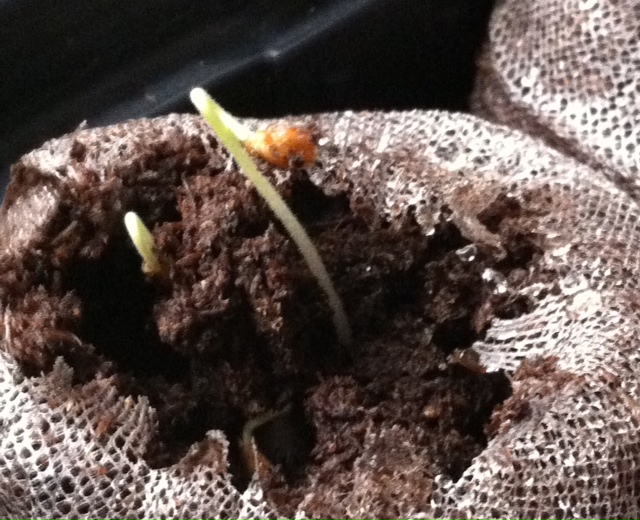
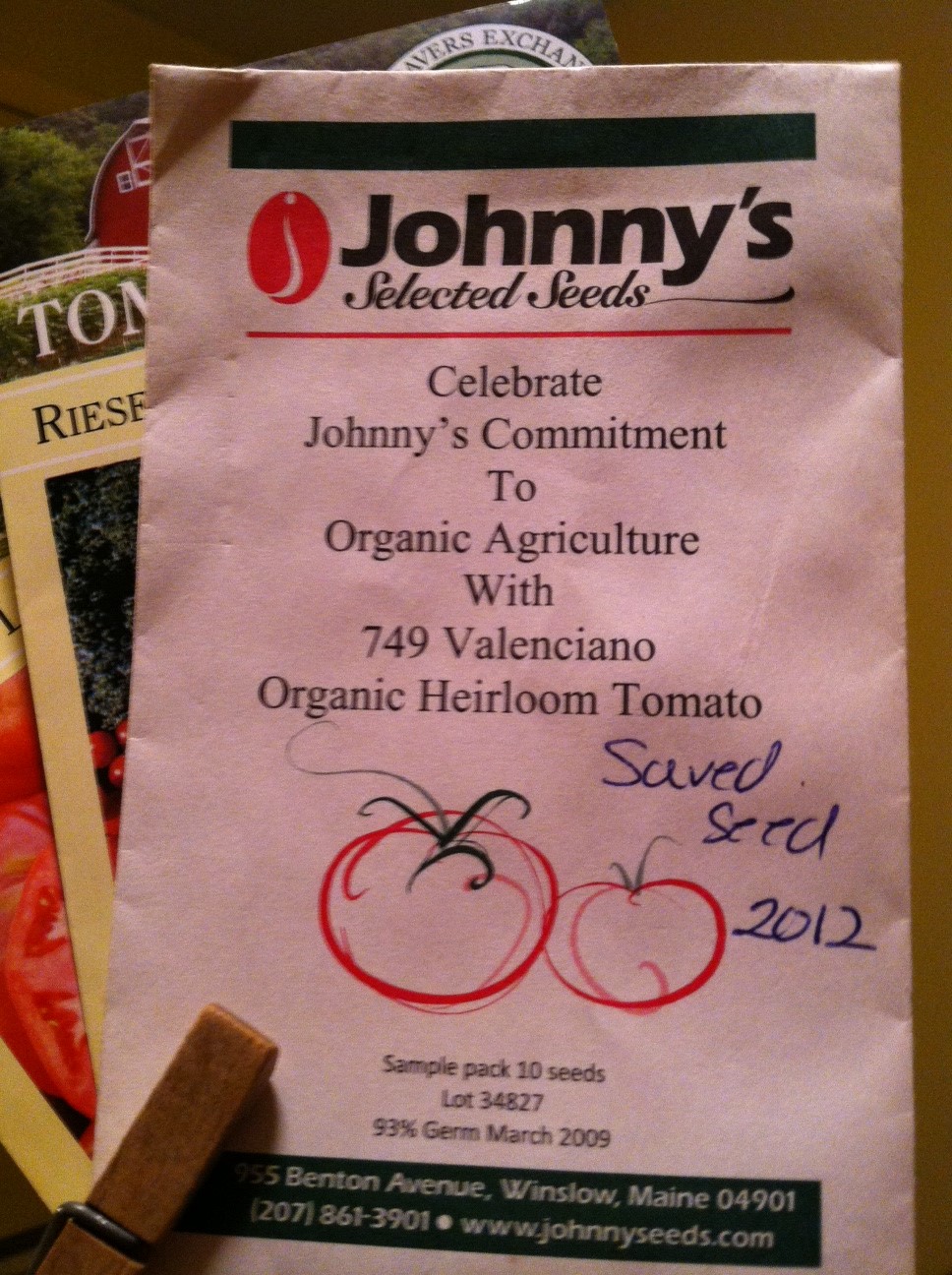
Wednesdays aren’t Twitter tutorial days; they’re “Tiny Steps Gardening Days.” In spite of yesterday’s snow, spring is still on schedule to arrive and many people will tweet about it. I will not be tweeting or blogging about spring today and I already have my “Minimalist” post queued up for tomorrow. I can report that all of the Valencia tomato seeds I planted on March 11 have germinated. No cotyledons have appeared yet.
Starting tomatoes in a chicken coop-sized condominium with East and West facing windows is a bit tricky. I use Jiffy peat pellets in the plastic “greenhouse” trays I save from year to year. I place the peat pellets in the tray, soak them with water, place two or three seeds in each pellet, place the greenhouse cover on the tray, and put the whole thing on a heat mat in a dark area. Moisture and heat helps the seeds germinate; I check every day for signs of life. When I see these signs, I take the greenhouse out of the dark and transfer it under my grow light.
We lost our power here at The Coop last night due to the storm and I wondered if my Valencia tomatoes were ready for evening darkness. Luckily, the power came back on during the night and my seedlings seemed unimpressed this morning.
Is my tomato starting system apocalyptically sustainable? No, it’s not. Without heat and light from electricity, there are no tomatoes. I’m not going to live in this chicken coop-sized condominium with East and West facing windows forever. As my friend Samantha Van Hopper might add “you can count on it.” I hope she tweets this.
One gardening item I won’t be tweeting about is the Hampton Victory Garden. I’m behind schedule on the mailing, although I know the majority of the gardeners will be returning this year. There won’t be many changes in the garden; the snow birds and the real birds will arrive and everyone will be twittering about things like lettuce, tomatoes, and peppers.
Someone just retweeted an interesting quote on Twitter. It’s a quote from a Tee Vee character on a make-believe show loosely modeled on the activities of a surreal place; a lot of people watch this show.
“Doesn’t matter what side you’re on; everybody’s gotta eat.”
–Frank Underwood
If a make-believe person on a Tee Vee show loosely modeled on the activities of a surreal place says something that is true, does it make it any less true? Prince Andrei wasn’t a real person either, but many of the things he said were true.
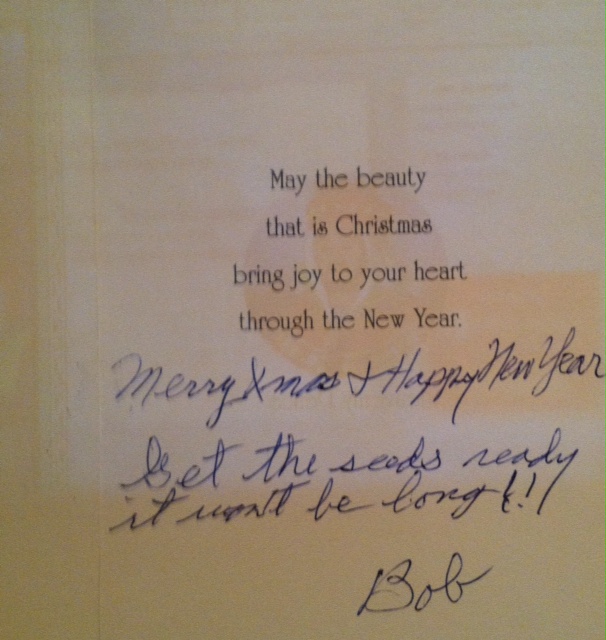
I’m going to end with some true and encouraging words from the real Uncle Bob. I’ll bet he’s out pushing snow around right now.
Aunt Tomato and Uncle Bob don’t giggle about growing food.
I woke up this morning to a bit of the white stuff on The Jeep. It’s on the roads, too. A late winter storm it is and I’m not going to make too much out of it. I’m going to work from home. My first batch of tomato seedlings, having all germinated, are oblivious to the winter weather shenanigans.
So am I.
Every time we have a “late winter storm” I think back to an April Fools Storm we had when I was in junior high school. My brother was supposed to have baseball practice, but it was cancelled. That’s all I can remember about it. No one freaked out; we just loaded our books into our duffel bags and walked home. It didn’t freak the baseball team out, either. They ended up having a winning season.
Don’t freak out today.
Time spent worrying about the weather robs people of moxie and as my mother likes to remind me, “time marches on.”
Just like that, “Seniors 80” takes on a whole new meaning and what value did worrying about snow and wind add to the picture?
Live the New England Snow Coma!
When developing a theme or a premise, a writer may reveal personal information which influences their opinion and affects their ability to be objective. “For purposes of full disclosure” is a pleasant way to begin such a revelation. When I discuss Hollywood celebrities and sports personalities, I remember to preface my discussion with the phrase “although I don’t have a Tee Vee, dot dot dot.”
When I read the New York Times article The Extraordinary Science of Addictive Junk Food by Michael Moss, I was amazed and horrified to learn how processed convenience food is created, manufactured, and marketed. The psychology and manipulation used to sell a plastic tray of pseudo meat, sugar, and salt was upsetting; for a moment, I couldn’t believe that any mother would give her children Lunchables. Who was buying these wildly popular proxies for a healthy lunch?
Then I remembered the importance of “full disclosure.” I’m not a working mother.
Back in the 1980’s, Oscar Meyer had a lot of baloney and wieners that weren’t selling. It was Bob Drane’s job to figure out how to market these products and like any corporate VP, he organized focus-group sessions with mothers. Step one is to identify a need. The women interviewed complained about time. They wanted to give their children a healthy variety of foods, but putting it all together every day was complicated and they were short on time.
The Lunchable was born out of these sessions.
I’m a busy person, but on the weekend I have time to work in the garden, go to Farmers Markets, and talk to local merchants. When I get home from work, it’s just me and my kale. I’ve made decisions about the food I’m going to buy and where I’m going to buy it. No one complains if there are no Lunchables in my reusable canvas bag.
If I want to experiment with a fun and attractive way to incorporate more cabbage and cottage cheese into my diet, I just do it and no one complains or says “gross.”
Everything in my “parfait” was grown and produced locally, but it required thought, calculation, and time to prepare. This was the first week my farmer friends had spinach from their high tunnel and I figured the healthy green vegetable would give my parfait a pop of color. Posting a picture here on my blog is a little focus group, but I’m not so naïve as to think working women with children are going to pack such creations in lunch boxes. For all I know, lunch boxes may be forbidden in public schools.
It’s not a moral failure if a person’s green food looks more like this.
Something is wrong with the way food is produced and consumed in America. People know it’s broken, but how can they slow down enough to chop cabbage, braise kale, and roast sweet potatoes? For every hand that comes between them and the sources of their food, a layer of processing and manipulation is added but a layer of time is peeled away. What is the mathematical formula for convenience food? What is the constant which makes it easy and tasty, yet devoid of nutrition?
I’d like a full disclosure from Oscar Meyer and the other wieners.
As some of my readers may know, I’m not Irish.
In a tip of the flat cap to the Irish, I picked up a “shake” at a giant hamburger chain; sadly, the minty beverage has been bastardized into a sorry mess I could barely recognize from the early days of its invention in 1970. The horrid treat was served in plastic, with whip cream and a cherry on top.
I sipped half of it and then dumped the rest down the drain when I got home.
I contemplated contacting the giant hamburger chain at their “How are we doing” toll-free number, but it didn’t seem like the best use of my time. Other disappointed nostalgic 48-year-old women have probably already written to them.
I checked my tomatoes.
This was the best green thing of the day; a little metaphorical four leaf clover.
A haunting novel, Rebecca, by Daphne du Maurier, begins with the following line:
“Last night I dreamt I went to Manderley again.”
A few months ago, I declared Wednesdays as “Tiny Steps Gardening Days” and committed to write about growing food. I stayed on task for a number of weeks; then something suddenly came up and I fell off the Tiny Steps writing wagon. One of my friends questioned me about my dereliction to duty with a gentle “And what happened to Wednesday gardening day? “ and I tossed and turned much of Thursday night, wondering what tiny steps I had taken lately on the self-reliant food front.
If I were to write the story of my blogging life this morning, it would begin like this:
“Last night I dreamt I went to pick tomatoes again.”
My first tossing and turning thoughts were about last year’s alfalfa seeds and adzuki beans. Watching them sprout and grow was interesting, but I was ho-hum about the actual product. I didn’t want to dream or write about them again.
Then, as I was drifting off to sleep, I thought about last year’s premature tomato seed start at the end of February. My eagerness resulted in slightly leggy tomato plants, but they grew well once they were in the ground. This year, Uncle Bob reminded me to exercise caution with my seed starting; it’s his warning that has distracted me from my purpose and skewed my writing to topics like tiaras, zombies, skunks, and forty dollar carrots.
My last waking thought was rumination on the tomato seeds I started on Monday, March 11; tomato seeds can take from 7 to 14 days to germinate so I had nothing to write about yet, even though I’m nervously hopeful about the seeds I saved them from last year’s delicious Valencia tomatoes. Time will tell if I write about tiny cotyledons next Wednesday.
When I woke up this morning, I wondered about Valencia, Spain. Commenter Loosehead Prop might have something to say about this place; he’s traveled a lot.
A Valencia town has an annual tomato fight every year called La Tomatina. The idea has spread to a few cities outside of Spain; it doesn’t sound like anything I’d be interested in and I’m happy to report there won’t be such an activity at this year’s Moxie Festival. We’ll stick with a fireman’s muster on Main Street.
Wide awake now, I’m taking a few tiny steps forward this Friday; I will start the remainder of my tomato seeds this weekend and I’ll get back on the wagon next Wednesday. Until then…
What gardens are haunting your dreams?
Last night was the fourth official meeting of the 2013 Moxie Festival Committee and I’m glad I’ve been able to attend all four. Being part of clubs, committees, and organizations is an important staple of small town life because the only way you can really get to know people is to, well, get to know them.
It takes more than one face to face interaction or a few e-mails.
An important agenda item we covered during our meeting was an update on the parade. It takes a special person to coordinate a parade; one of my father’s old friends from high school, Noyes Lawrence, coordinated it in the early days of the festival. He said the best way to describe success is if it’s a “two stogie parade.” This year, Gina Mason is once again coordinating the parade and she’s got some interesting and entertaining leads developing. I can’t even imagine which side of the brain is required to logistically and neatly organize all the details of the biggest parade in the state of Maine; I’m glad Gina’s got that kind of brain. We marched in a parade together once, with batons.
I do not have a baton or a parade brain, as evidenced by my attempt to get Bill Lee as the grand marshal.
One of the categories of parade entries that are always welcome are “floats.” This category covers more ground than one might think and can range from something as simple as a decorated baby buggy to an elaborate creation on the back of a large flatbed truck. Over the years, I’ve fantasized about the type of float I would make if I just had a little bit more time. I’ve even talked out some of my ideas with Faye, who has won awards for the floats she’s built.
It’s not complicated; a person could dress up their tractor and make a float.
There are ribbons for the best floats in each of the following categories:
I don’t think this will be my year to make a float for the Moxie Parade, but I’m sure there are one or two people reading this blog right now who will comment and describe a never-been-tried float idea.
Sunday at church, I sat next to Katie K., a young and talented singer. I’ve heard her trained voice many times in the past 2 years, but I’ve never sung alongside her. We opened our Trinity Hymnals and began singing the familiar tune, “Old Hundredth,” or All People that on Earth do Dwell.
As I focused on the words and the tune, Katie’s clear and well-modulated voice drifted above my own plainer tones and those of the congregation. Hearing her practiced vocal method encouraged me to try to remember some of the things I had learned about singing in junior high school and by the fourth verse, I thought my voice improved just by proximity to talent.
Following church, I asked her some questions about her singing career. She began singing and playing the piano at an early age and participated in choral singing through high school. She was studying piano performance in college; interestingly, it was not until her junior year that she took voice lessons.
I asked her to tell me more about her current practice routine. She studies with a professional voice coach and sings for at least one hour per day. Her additional practice includes more than singing, as she studies musical scores. Because many classical and operatic scores are in languages other than English, she studies transliterations using the International Phonetic Alphabet or IPA. A singer can sing in three or four languages without actually being fluent in three or four languages by using IPA tools.
I asked her if she had ever “slacked” on the practice of her craft. Busy working following graduation, Katie stopped singing for almost two years; she said that although she did not “forget” how to sing, some of her skills became “rusty” and it took more effort to sing. She said this is why being a professional singer is a full-time job. She said her guiding maxim is “an amateur singer practices until she gets it right; a professional practices until she can’t get it wrong.”
Now 28, Katie K. is leaving the world of work to continue her study and practice of vocal music. She begins post-graduate work in September at the University of Northern Iowa in Cedar Falls.
**********
In 2008, Malcolm Gladwell wrote a book called Outliers, based in part on the “10,000 hour rule.” This idea, that mastery or greatness in a discipline requires at least 10,000 hours of practice, was studied by Swedish psychologist Dr. K. Anders Ericsson. In a June, 2007 Harvard Business Review article titled The Making of an Expert, Ericsson outlined three components for mastery:
Applying this concept to professional endeavors and assuming a forty hour work week, 50 weeks per year, it could take approximately 5 years to master a job. Do most people stay in jobs that long? No, they don’t. While there are other factors to mastery, the need to practice a skill, craft, or a profession is obvious.
If I think about blogging as a craft I’d like to master, considering I invest approximately 2 hours per day on preparing, writing, and executing the technical details, it will take me almost 14 years to be an expert.
Yikes.
I’m not a self-help guru and telling someone it may take 10 to 15 years of practice to become excellent at something is not going to make me a popular guest on the late-night talk show couch. If I were a self-help guru and you were asking me for some advice, I’d tell you to read the Harvard Business Review article, available in the Wikipedia entry about Dr. Ericsson. Then, considering what skills and talents you have, determine if you have the time required to achieve mastery.
It’s The Old Hundredth squared.
Did I promise not to complain about the change from Standard Time to Daylight Savings Time? No, I made no such promise.
This travesty, foisted upon us by some bug collector who wanted more daylight to collect his specimens, wreaks havoc with sleep and productivity. Some researchers now question whether it might increase a person’s risk for a heart attack. Of course, if more people have heart attacks, traffic at hospitals and health care facilities will increase and more prescriptions for various pharmaceuticals will be needed. I’m sure there are one or two economic Einsteins in our fair nation’s capital who are rubbing their hands together with glee right now, thinking how this “business traffic” will influence some marker of the “economic recovery.”
I found a few articles in the mainstream press questioning the logic of messing with a nation’s sleep, but like the implementation of Facebook’s timeline, the fury will quickly fade as some other bright, shiny thing pops up on the virtual horizon. My Facebook news feed has no complaints about the time change today and three articles about the likelihood of an imminent zombie apocalypse.
In a nation obsessed with zombies, I’m sure no one will notice me staggering around the office or face-down at my desk.
I can hear the sounds of one hand clapping right now, so I’d better pound some sunshine.
Serenity someday!