Last Saturday, I was invited to my brother’s house for an afternoon “working session.” We toiled away in his upstairs home office while his wife, Miss Mary, visited with her sister, Dianne. As we went over story and essay ideas for his next book, I could hear the sounds of kitchen tools mixed in with laughter and conversation. At six o’clock, we were summoned to dinner.
Sharing a meal with friends and family is a special treat.
Here at The Coop, my evening meal is often eaten standing up at the counter and it might consist of some cheese and crackers washed down with raw goat milk. The Encyclopedic Cook Book makes it seem easy to be a gal on the go with a meal routine.
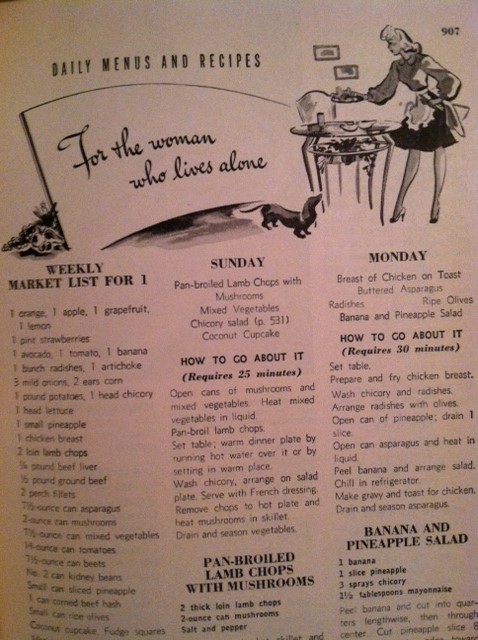 (From Culinary Arts Institute’s The Encyclopedic Cook Book, copyright 1950.)
For a while, it seemed like the almost-sacred act of family mealtime might make a comeback. In her 1980 basement, Doris Christopher had an idea to help preserve family mealtime and she created The Pampered Chef. So enticing was the idea, I became a Pampered Chef consultant in the early 1990’s. After a day of working at my first Big Corporation, I’d lug my two crates of tools and baking stones into someone’s house and demonstrate simple recipes. I developed my “pitch” or “testimonial” about why I wanted to be a successful consultant. The Pampered Chef “business opportunity” was going to help me become the person I wanted most to be, which was a stay at home wife and mother. Even though I didn’t have any children, if I just sold enough pizza stones, this life might be possible.
After my first few months of minor success, my up-line director and I traveled to Chicago for a Pampered Chef national conference. It was a well-orchestrated event and although I didn’t get to meet Doris Christopher personally, her stage presence was just as humble and wise as she seemed in the various consultant publications I received. When I got home from Chicago, I set up my own basement office in the suburban Cape Cod-style house my husband and I owned. I toiled away at my “direct sales opportunity” for another year until my day job demanded more of my energy.
Things didn’t turn out exactly as I had hoped.
The Pampered Chef, Ltd. is still in business. Berkshire Hathaway acquired the company in 2002 and I’m glad things turned out well for Doris Christopher. I still have most of the kitchen tools and baking stones from that entrepreneurial venture and I do most of my cooking on the weekends when I try to stock-pile meals for the coming week. It’s not perfect and it’s not like having a meal with family and friends.
I’m sure someone is working on a smart phone application for it, though, and when they do I’ll be the first person to download it. Until then, I’m grateful to the people who keep mealtime sacred and occasionally invite me to their table.










 Julie-Ann Baumer