
Young ladies used to embroider tea towels for every day of the week and then put them in their “hope” chest.
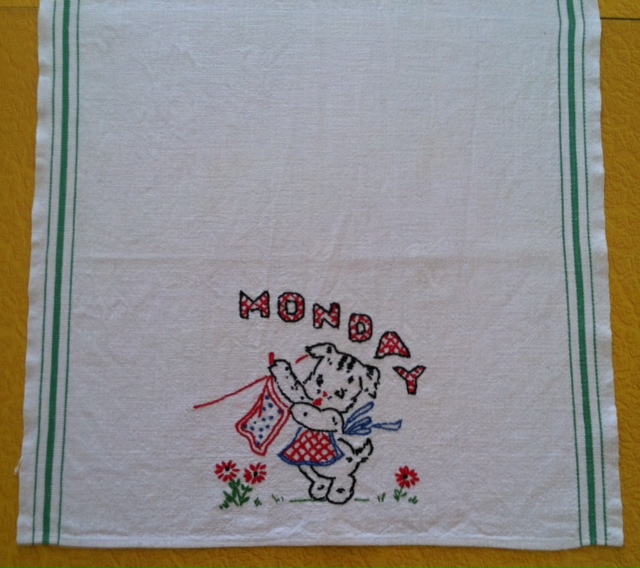 Somewhere, I have a “Tuesday.”
Young ladies used to embroider tea towels for every day of the week and then put them in their “hope” chest.
Somewhere, I have a “Tuesday.”
Winter storm PAX is looming in the distance and threatening to disrupt life across the southeastern United States. My fingers stall on my keyboard because I don’t have anything to say about weather; I’m not a weather puppet. I don’t understand why every weather percolation needs a name, but it’s probably part of some scheme to make sure FEMA funds are distributed correctly if anyone breaks a nail driving over icy roads. It’s oddly ironic that some brilliant puppet named the storm the Latin word for PEACE. By design, I guess, since those who know the meaning of the word will be searching for other disgruntled word lovers in the blogosphere and those who don’t will be searching for the meaning. When millions of men, moms, and marchers put PAX into search engines, this causes “Winter Storm PAX” to “trend” and creates hysteria. Hysteria causes fear and fear makes men, moms, and marchers run out to buy milk, bread, and shovels and the GDP rises like a balloon.
The You Ess of Eeeey (said like Fonzie) will be in the lock down of economic recovery by noon!
Meanwhile, back in Lisbon Falls, Maine, I’m looking at a list of the town gardens, formerly the work of The Green Thumb Gang. For a small town with a sputtering economy, we have almost 50 garden spots, many maintained by men, moms, and marchers who toil loving hours once the snow melts. We had a meeting on Monday night and it was good to meet some of these other gardeners. The grand dame of the Green Thumb Gang, my friend Faye, was there and she reminded us of the history behind the gardens. With all this weather hysteria, it’s easy to forget that some of our town gardens were created to honor the memory of men and women no longer with us, like “The Thomas Field Memorial Garden.” Tommy died at the Battle of Mogadishu, or Black Hawk Down.
Then there’s “The Wheel Garden.” Faye considered renaming this spot “The Magnet Garden” because Happy Motorists keep driving into it. The most recent drive-by bashed apart two of the irons wheels (from the old Worumbo Mill).
One of my father’s friends, Noyes Lawrence, works on the Route 9 Strip Garden. It’s a dangerous little island at the base of Route 9 and we’re renaming it “The Old Man Garden.” Old Noyes is a good old sport.
A sport of another sort, Reggie and I were talking about some of my Lady Alone Traveler trips and how a town’s “walkability” made it a better destination. Then Reggie asked me if I’d ever thought of starting a volksmarching club in town. I hadn’t thought of such a thing, but while I was sitting at the garden meeting, studying the list and thinking about the history of each garden, the wheels in my brain started turning. I could imagine some volksmarching from garden to garden. How difficult could it be? It would make a good story, too. With all of this in mind, I’ve volunteered to help on the garden map project.
The march is on.
For the last few weekends, I’ve taken “day trips” here in Maine, exploring new and old places within an hour’s drive from my house. On Friday, my Jeep started making a clickety chugging noise and I knew there would be no Lady Alone Traveler trip this weekend. I bummed a ride to the Winter Market with my friend and stayed close to home. The Jeep was running, but not well enough to risk driving too far. My thoughts occupied by the inability to “get up and go,” I contemplated my addiction to oil.
Have you ever considered what you would do if you didn’t have a car? How close is the nearest grocery store? Could you walk there? What about the “town” or “city” you live in? Can you walk to a bank, a post office, or a library? If you can, do you ever “just do it” instead of going by automobile?
Even though I am a regular reader of various Peak Oil writers, I know I’m still as addicted to my automobile as everyone else. It would be hypocrisy for me to say I am “more green” than another because I telecommute to my job and even though I have made changes in my life that require me to travel less, the Jeep’s clickety chugging noise still filled me with dread.
I was trapped.
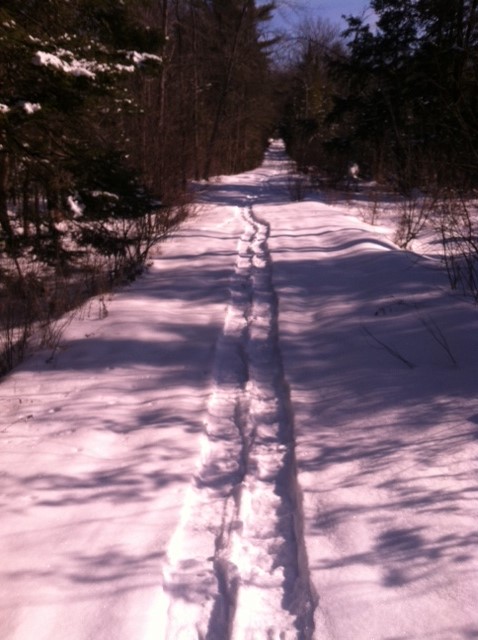
Considering short distances safe, I drove to The Farm yesterday. The snowmobile tracks went all the way from the end of the town road to Baumer’s Field and then the easy-walking tracks stopped. It was difficult walking in the fresh, loose snow; I put on my snowshoes and trudged along, blazing a trail. I contemplated life without oil and I remembered a time in my life when I thought it might be interesting to be a professional “trailblazer.” The idea of getting paid to be outdoors on cross-county skies or snowshoes intrigued me until I learned there were no such jobs available. Being a postal carrier was the closest career to trailblazing, but my high school personality indicator tests pointed me towards a different career.
Blazing a new trail is difficult work.
 Wait.
Wait.
Is it really? Driving my Jeep a few miles, trudging around in the snow, driving home to a warm house, eating scrambled eggs, these are all the luxuries of a prosperity I take for granted.
So begins another Monday, perplexedly at war with the modern world but having nowhere else to go.
Last week, some pop culture consumer good sailed over the transom, a “buy this and save the world” item like Kashi cereal bars and compact fluorescent light bulbs. Since buying one thing will not save the world, I made a vow I would never buy the unnamed product.
I wrote Reggie a note about it and told him how much I hated false promotions, often perpetrated by a well-meaning man or woman who unfortunately ends up lining the bulging pockets of a faceless corporation. I wrote quite a rant and I used the words “hate this shizzle.”
His response surprised me.
“Think about whether it’s worth the emotional commitment that hate requires.”
 It’s worth thinking about today.
In the last decade, I’d like to think I’ve become less interested in shopping. Mostly confined to farmers’ markets and antique shops, my urge to peruse and consume is diminished. For many reasons, I’ve tried to redefine myself as any number of things besides a consumer. You can’t take it with you and I’ve heard it said once or twice “you never see a moving van behind a hearse.”
I wasn’t always that way and yet as I look back on my consumer life, I realize how naïve I was about the whole shopping racket.
When I worked part-time retail jobs after college, I stayed out of the back rooms where merchandise arrived in big cardboard boxes. “Better Women’s Clothing” was my department at Jordan Marsh and I would spend my hour or two “merchandising” the department, cleaning up the dressing room, and trying to get my register to true up at the end of my shift. I worked in the outlet trenches, too; Anne Klein, in Freeport, before the label went into the toilet. Back in the early 1990’s it was all very “high end” and expensive; the store manager’s name was even Mercedes.
Bargain shopping wasn’t for me either and the first time I went to the now-defunct Filene’s Bargain Basement in Boston, I wanted to throw up a little because it was dirty and crowded. It smelled like smoke and the subways. Even if the automatic mark-down system could make a silk purse out of a pig’s ear, who wanted a silk purse anyway? Then there was the famous running of the brides…
Yes, everything was always clean and bright in my little consumer-retail world, spritzed lovingly with some Jean Patou’s 1000. My days and nights at The White Sarcophagus would change all that and remove the moss from my eyes.
 The whole vile scheme would take on a never-before seen ugliness and reveal new levels of decay. But I’m getting ahead of myself.
**********
The day following my manicure, I drove back to the strip mall where I had met spa and bridal salon owner, Bay Bracken. The door to the bridal salon was hidden around the corner of the spa’s façade, but on that particular November day, a headless mannequin wearing a big, white tumbleweed of a dress stood on the sidewalk near the entrance. I walked up the stairs and entered a strange new world of white. A smartly dressed young woman was kneeling on the floor, trying to tape together a broken vacuum nozzle with heavy duty packing tape. The vacuum bag was on the floor, too, and a small pile of dirt spilled out onto the carpet. She looked up and asked if she could help me. I asked for Bay; she was downstairs at the spa. The young woman said she would call her. She left the broken vacuum, brushed herself off, and slipped into the back room.
I poked around the 2,500 square foot space.
The far wall was made up of a long rack of dresses, broken in the middle by a three-way mirror. In front of the mirror was an armless, backless upholstered rectangular…thing. It wasn’t a couch, it wasn’t a bed, and it wasn’t quite a divan. A few magazines and bridal veils were on one end. I would soon learn that it was the magical bridal barge, the seat of all matrimonial dreams.
The decor was purposefully sparse; slate gray carpets, grey-tinted ivory walls, and black velvet swags over the front window. A neo-French provincial desk was next to the back room’s door from which I could hear the young woman’s voice. IKEA meets Restoration Hardware via Breakfast at Tiffany’s.
The young woman reappeared and said Bay would be up in few minutes; remembering her manners, she introduced herself as “Veronica” and suggested I have a seat on the bridal barge while she took a shoe inventory. I sat down and Veronica, having forgotten the broken vacuum, started counting shoe boxes piled under the long dress rack along the wall. I flipped through the latest big fat issue of Bride magazine and waited for Bay.
Time stood still.
Ayuh, it’s my favorite. It would make a nice gift, too.
 Just perfect for Lady Alone Traveler.
Yesterday, February 4, 2014, John Mulligan apologized to the Senate Judiciary Committee on behalf of Target. Shoppers in aisle three may remember last month’s news story about the hip chain—a data breach that compromised the data of millions of consumers.
The Executive Vice President and Chief Financial Officer said “I want to say how deeply sorry we are for the impact this incident has had on our guests…”
I’m sure Mr. Mulligan is a perfectly lovely man and he looks sufficiently contrite in an online photo montage. He also looks determined; he is reported to have said that the chain is now accelerating implementation of a new, smarter point-of-sale technology that will provide shoppers in aisle three with additional safety as they peruse and purchase the many things they may or may not need.
I’ve been a “guest” at Target once or twice; I bought some Mrs. Meyers lavender-scented laundry detergent. Something about the big red bull’s eye hovering over the door made me uncomfortable and I wondered if the target was actually on me and my pocketbook. I haven’t been back since. This morning’s mental perambulations around the retail perimeter left me wondering “what would the world be like if Americans weren’t consumers?”
Sigh…that’s like imagining a world without automobiles and speeding motorists.
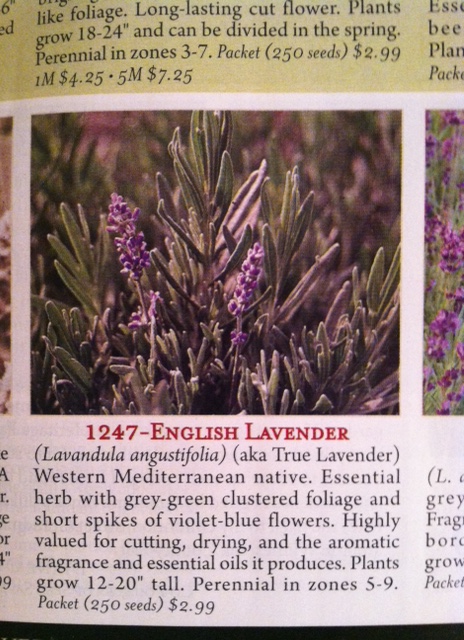
After I skimmed the Mulligan story and remembered Mrs. Meyers, I did some research on lavender. One of my friends had asked me about growing the fragrant plant which grew in abundance at the Communiss Garden. Lavender is trendy and the fragrant farms are often “agritourist” destinations. Consider Sequim, Washington. It’s the “Lavender Capital of North America” and attracts tens of thousands of visitors each year.
Growing lavender is not without breaches and schisms. In 2011, a group of lavender farmers broke away from the Sequim Lavender Growers Association to form the Sequim Lavender Farmers Association, citing philosophical and administrative differences. They host their own festival, too, and now Sequim celebrates more lavender-centric events than ever. It’s the epi-center of Lavandula although there’s no Target store there.
I don’t need to grow lavender. I don’t have plans to start a lavender farm or a festival and even though lavender is trending right now, the bubble could burst tomorrow. Growing lavender cannot save the world. That would just be “Lavandu-mania” talk.
I’ll order one package of lavender seeds this year and keep it simple.
 Tiny Steps!
What is it about “Groundhog Day” that is most offensive? Is it that the garden-destroying rodent is elevated to Zeus-like status for poking his ugly head out of a burrow on the second day of February? Or is it that Punxsutawney, Pennsylvania’s economy now subsists on a hope that people will flock to the town to see a rodent? Once upon a time, the Pennsylvania town had factories, foundries, and mills. Now, they’ve only got Phil.
Could it be possible that Peyton Manning was distracted by the shadow puppetry of a groundhog yesterday as the Seattle Seahawks soundly defeated the Denver Broncos in the American spectacle called The Super Bowl?
There are other ways to know which way the wind blows when it comes to weather and seasonal prognostications. Here in New England, one need only drive around on secondary roads for a few minutes. Sometimes the “groundhogs” are advertised by a sign on a telephone pole.
BUMP.
New Hampshire, a state more economically prosperous than Maine, is always prompt in posting their “groundhogs” in February.
Frost HEAVE.
I’m not a scientist or a weather puppet, but my observations are sometimes accurate. So I propose experts and marketers use frost heaving and secondary road speed decreases as a way to predict winter’s end. Small towns could have competitions to see which ones had the most frost heaves and bumps. Unemployed men and women could park lawn chairs by particularly heinous heaves and measure vehicle speeds with radar guns provided by local police departments. The results, telegraphed in staccato-like reports over radio, Tee Vee, and social media, would be part pseudo-science, part entertainment, and part economic development.
There would be tee-shirts and commercials and…MONEY!
Meanwhile, in the little village of Head Tide, Maine, I saw very few frost heaves. I went there on Saturday to see Edwin Arlington Robinson’s birth home and complete the “research” from last Sunday.
The house, located at 66 Head Tide Road, is currently for sale for a cool $225,000. It sits pleasantly along the Sheepscot River, only a short walk from what remains of the old Head Tide Dam and the former general store, now The Wizard of Odds and Ends and Antiques.
There aren’t many frost heaves in Head Tide and there isn’t much traffic. No groundhogs, either. I parked my Jeep by the old dam and walked around the village. I walked up one hill and peeked in the windows at The Old Head Tide Church. Then I walked over the bridge, around the corner, and made my pilgrimage to the Robinson house.
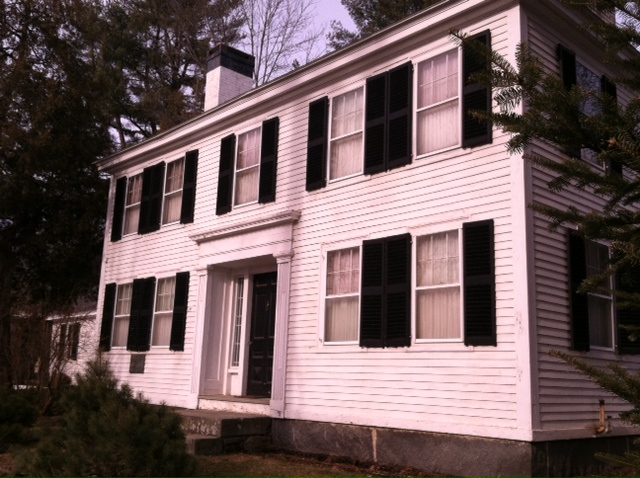 The weather being pleasant, I turned around and headed north up Head Tide Road, climbing a steep hill for about half a mile. No sidewalks, but since there were no frost heaves, no traffic, and no groundhogs, it was no problem. Halfway to the top of the road sat a stately brick home.
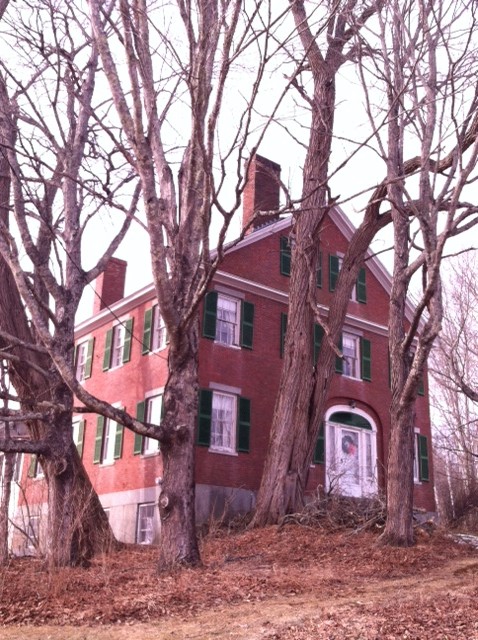 No signs of life.
I wondered if anyone lived in this house. There were summer sheers in the windows, aged but with only one obviously disintegrating. Someone had placed an artificial Christmas wreath on the front door. Was it this year or five years ago? It was a house built for stories, afternoon tea, and horse-drawn carriages. A house for another time.
I wondered what it might be like to live in such a large house on a hill. Edwin Arlington Robinson wrote a poem about this once.
When I got back to the dam, I smelled something fresh. It smelled like ice, dirt, and grass. It was refreshing and I wondered if this, too, was a harbinger of spring. Walking around and smelling it was much lovelier than watching a big old brown rat crawl out of a hole.
The funniest thing was I smelled that same smell again when I got home, right in my own driveway. I hadn’t needed to go anywhere or do anything to observe the signals of the seasons in the natural world. I didn’t need to travel to Head Tide or Punxsutawney at all.
Can anyone make a commercial and a tee-shirt out of that?
It’s that day. Not here, though.
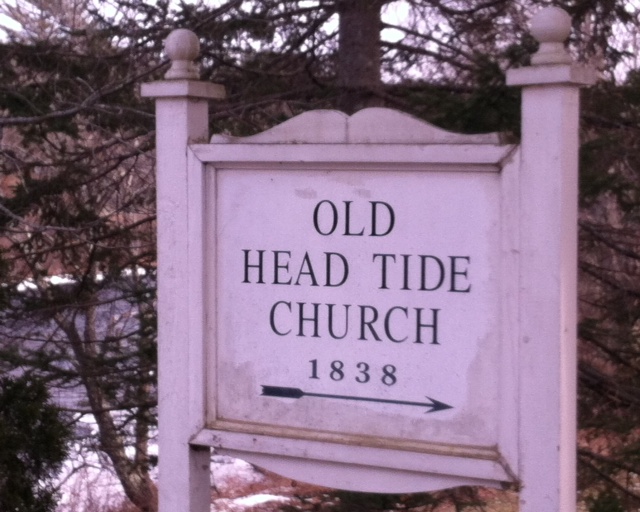 It’s only open to the public on Saturdays in July and August, from 2-4 and not on that day.
When was it? How long ago? It seems like a lifetime. It’s January now, 2014. It was November, 2004, almost ten years ago. Why had I stopped at that particular strip mall, one of so many along that familiar road? I was looking for a manicure, I think. Unemployed or not, it was important to me at that time.
I had passed the “skin care and nail salon” many times, but this particular November day, I stopped. The receptionist studied the appointment book dubiously, then told me the owner was free; she pointed me towards an adjoining room, decorated in the summer cottage style. Lazy white gauze sheers hung on the windows and the oversized slipper chairs were upholstered with striped muslin. Framed images of shells and sand complemented the jars of salt sea scrub, pumice stones, and nail polish on a shabby chic repurposed chiffonier.
No one said “pick a color” so I sat down and began skimming one of the bridal magazines on the chair next to me. Like Vogue for brides, these publications are primarily advertisements. Alfred Angelo, Demetrios, and Eve of Milady were just a few of the designer names I recognized from sitting at bridal showers in my twenties. I didn’t know it at the time, but I had much more to learn about the bridal business.
Ten minutes later, a woman came in. She was dressed in black slacks and tee-shirt, topped with a white lab coat. She introduced herself as “Bay” and asked me to sit at the manicure station, another repurposed reproduction. This one was a Louis Quatorze writing desk.
We chatted a bit and she asked me if I was getting married. I laughed and said no. I told her I was divorced and that I had just started a small personal organizing business. I told her it seemed like there might be some synergies between organizing and wedding planning. I must have sounded confident, charming, and convincing, because she told me she owned a small bridal salon and she needed someone to organize and market it. Owning the skin care salon was all-consuming and the bridal business, we both agreed, had so much potential for growth and profit.
Taking me into her confidence, Bay said quietly “Brides-to-be will pay anything for a white dress with a few beads sewn on it. Ka ching.”
Having been suckered into a few overpriced scraps of fabric in my day, I returned the knowing look and nodded my head. “Where’s your bridal salon?”
She pointed with her index finger and said “it’s right upstairs.”
 She finished applying a top coat to my nails and we agreed to meet at the bridal shop the following day to discuss employment options. No handshake possible due to my tacky lacquer, Bay hurried off with a smile to a micro-dermabrasion emergency.
My life was going to change. I could just feel it.
 Julie-Ann Baumer